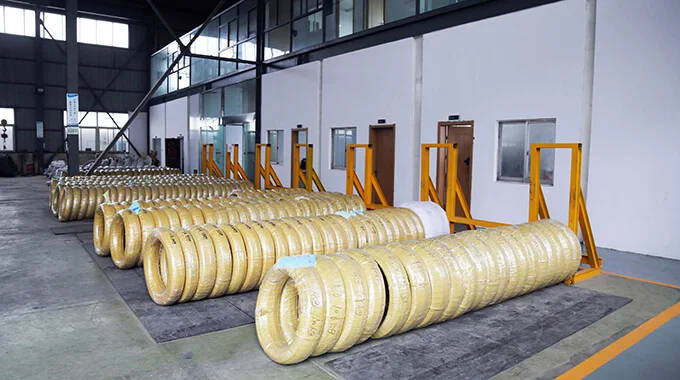
Technical data for 42CrMo4 cold heading wire, with applicable standard ISO 4954-Annex C. View the chemical composition, mechanical properties, and related technical requirements for the current grade.
Table C.1 Combinations of delivery heat treatment conditions, product forms, and applicable requirements
2. Chemical composition
Table C.3 Chemical composition of boron-alloyed steel grades for quenching and tempering (applicable to cast analysis)
Elements not quoted in this table should not be intentionally added to the steel without the agreement of the purchaser,except those intended for finishing the heat.All reasonable precautions shall be taken in order to prevent the addition of such elements from scrap or other materials used in the production process,which can affect the hardenability, mechanical properties and applicability To improve the performance of cold heading,it is possible to add Al:0,020 %to 0.050 %.
a b
Maximum values unless otherwise indicated. In the case of steels with hardenability requirements (see Table C.8),minor deviations from the specified limits are permitted (with the exception of sulfur and phosphorus) c Lower silicon contents may be agreed at the time of ordering,in which case due consideration should be given to the effects that could result for what concerns the specified properties such as,for example,hardenability. d Where a maximum chromium content of 0,30 %is specified,a minimum level may also be agreed at the time of enquiry and order e In order to obtain a core hardening for the steel grade 30MoB1,the lower limit of Cr shall be 0,15 %and may be agreed at the time of enquiry and order.For certain applications, the higher limit for Cr may also be lowered by agreement at time of enquiry and order.
3. Mechanical properties
Table C.5 - Mechanical properties of boron-free alloy steel grades
Steel name
Diameter
Delivery condition
+AC or +AC+PE
+AC+C+AC
+AC+C+AC+LC
above mm
up to mm
Rm max. MPa
Z min %
Rm max. MPa
Z min. %
Rm max. MPa
Z min. %
42CrMo4, 42CrMoS4
2
5
620
60
660
58
5
40
630
58
610
60
650
58
4. Hardenability requirements
Table C.7 - Hardness limits for boron-free steel grades with specified (normal) hardenability (H grade)
Steel name
symbol
Austenitizing temperature °℃±5℃
Limits of range
Hardness HRC at a distance from quenched end of test piece(in mm) of
1
2
3
4
5
6
7
8
9
10
11
13
15
20
25
30
42CrMo4
+H
850
max.
61
61
61
60
60
59
59
58
56
53
51
48
47
46
45
Table C.9 - Scatter bands of hardness limits for boron-free steel grades with restricted hardenability (HH and HL grades) a
Steel name
Symbol
Austenitizing temperature ℃±5℃
Limits of range
Hardness HRC at a distance from quenched end of test piece(in mm) of
1,5
3
5
7
9
11
13
15
20
25
30
35
40
45
50
42CrMo4, 42CrMoS4
+HH
850
max
61
61
61
60
60
59
59
58
56
53
51
48
47
46
45
min.
56
56
55
54
52
48
46
44
41
39
38
36
36
35
34
+HL
max.
58
58
58
57
56
54
53
51
49
46
44
42
41
40
40
min.
53
53
52
51
49
43
40
37
34
32
31
30
30
29
29
min.
53
53
53
53
52
51
51
51
51
50
50
50
50
49
48
min
50
50
50
50
49
48
48
48
48
47
47
47
46
45
44
This table is not applicable to steels ordered with a restricted range of carbon content,see footnote c)in Table C.2.
Table C.10 Maximum diameter for achieving at least 90% martensite in core hardness testing (+CH grade)
Steel name
Symbol
Austenitizing temperature in the core hardening testa C±5℃
Min.core hardness ( 90 %martensite structure) HRC
Maximum diameter to ensure 90 %of martensite in the coreb mm
42CrMo4
+CH
850
50
21
a As a guideline,a hardening time at temperature of at least 30 min is recommended. The maximum diameters stated are those attainable with the lowest hardenability within each steel grade.Using +HH grades the maximum diameter can be increased.
FAQ
Frequently Asked Questions
What are the primary use cases for 42CrMo4 CHQ wire?
42CrMo4 is an alloy steel grade used where strength, toughness, and hardenability requirements need to be reviewed for cold forming applications. The product page lists automotive, construction, machinery, and other industrial sectors as primary applications. Chromium (Cr) and molybdenum (Mo) are the main alloying elements.
What standard is referenced on the 42CrMo4 page?
The page references ISO 4954 — Steel grades and technical delivery conditions for cold heading and cold extrusion — with Annex C providing grade-specific data.
What delivery condition information should be confirmed before ordering 42CrMo4?
ISO 4954 Annex C lists multiple delivery condition combinations. Before ordering, buyers should confirm: ① The required delivery condition (e.g., +AC annealed, +AC+PE annealed & surface finished, +AC+C+AC, or +AC+C+AC+LC); ② Mechanical-property requirements corresponding to that condition; ③ Whether hardenability requirements apply. Specific applicability depends on the standard edition and supplier agreement.
Can hardenability and mechanical property requirements for 42CrMo4 be discussed with the supplier in advance?
Yes. ISO 4954 Annex C contains relevant technical tables, but the applicable row and requirement must be confirmed against the order condition and standard edition. Providing target specifications and performance requirements during inquiry is recommended.
What information should a buyer provide when requesting a 42CrMo4 quotation?
For an accurate quotation, provide: ① Grade and standard (42CrMo4 / ISO 4954); ② Required delivery condition; ③ Target specifications and delivery-condition requirements; ④ Mechanical-property requirements; ⑤ Surface quality requirements (decarburization depth / surface defect limits); ⑥ Whether inspection reports and traceability documents are required; ⑦ Packaging preference (coils / straight lengths / wooden crates). More detail leads to a more accurate quotation.
Chemical composition, mechanical properties, tolerances and delivery condition must be confirmed against the applicable standard edition, customer drawing and order specification.
RFQ CHECKLIST
What to include in the enquiry
Grade and applicable standard
Diameter or section, delivery condition and quantity
Drawing, forming route or failure photos when available