
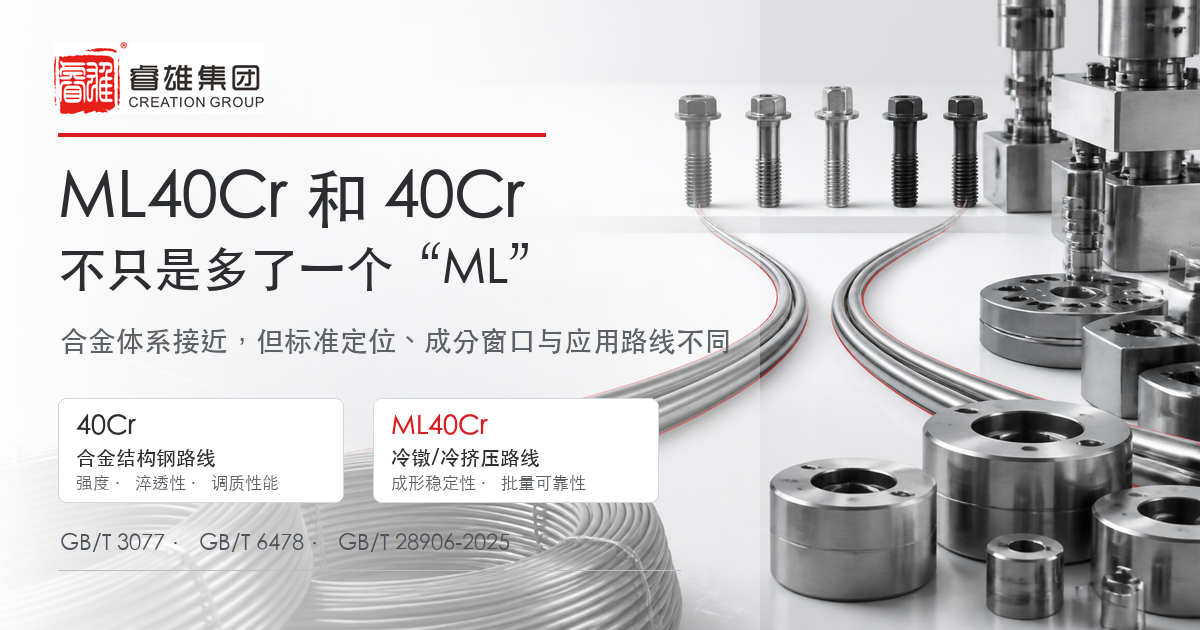
In the selection of cold-heading wire and high-strength fasteners, 40Cr is a very common grade. Many customers, upon seeing ML40Cr, naturally assume: Is it simply 40Cr with an "ML" prefix?
In fact, this cannot be understood so simplistically.
Although 40Cr and ML40Cr have similar alloy systems—both belong to the Cr-series steels—their standard classifications, chemical composition controls, and application paths are not entirely identical. 40Cr leans more toward the alloy structural steel category, while ML40Cr is oriented toward cold heading and cold extrusion forming applications.
I. Different Standard Classifications
40Cr is typically classified under GB/T 3077, “Alloy Structural Steels,” and is a commonly used quenched-and-tempered structural steel, offering good strength, hardenability, and overall mechanical properties. It is frequently employed for shafts, gears, connectors, machine parts, as well as certain fastener products.
The “ML” in ML40Cr emphasizes its suitability for cold heading and cold extrusion applications. It generally corresponds to GB/T 6478, “Steels for Cold Heading and Cold Extrusion.” If hot-rolled wire rod is being procured, it should also be evaluated in conjunction with GB/T 28906-2025, “Hot-Rolled Wire Rod for Cold-Heading Steel.”
In other words, ML40Cr is not merely a renamed version of 40Cr; rather, it represents a material specification that places greater emphasis on stable cold-forming performance.
II. Differences in Chemical Composition Among the Three Standards
Chemical compositions are given as mass fractions, in %.
| Standard | Grade | C | Si | Mn | P | S | Cr | Mo |
|---|---|---|---|---|---|---|---|---|
| GB/T 3077-2015 “Alloy Structural Steels” | 40Cr | 0.37–0.44 | 0.17–0.37 | 0.50–0.80 | Not listed in the screenshot | Not listed in the screenshot | 0.80–1.10 | — |
| GB/T 6478-2015 “Steels for Cold Heading and Cold Extrusion” | ML40Cr | 0.38–0.43 | 0.10–0.30 | 0.60–0.90 | ≤0.025 | ≤0.025 | 0.90–1.20 | — |
| GB/T 28906-2025 “Hot-Rolled Coils of Cold Heading Steel” | ML40Cr | 0.38–0.43 | 0.10–0.30 | 0.60–0.90 | ≤0.025 | ≤0.020 | 0.90–1.20 | — |
Note: The above table is excerpted from the standard screenshots provided. The P and S elements are not shown on the page of the GB/T 3077-2015 screenshot; when using this information in practice, it is recommended to refer to the complete standard text or the mill’s certificate of quality.
III. The Practical Significance Behind the Composition Differences
First, the carbon content ranges differ. For 40Cr, the carbon content is 0.37–0.44%, while for ML40Cr it is 0.38–0.43%. The narrower carbon window of ML40Cr helps ensure consistent performance during batch heat treatment and stable post-cold heading strength.
Second, silicon content control differs. In 40Cr, Si is 0.17–0.37%, whereas in ML40Cr it is 0.10–0.30%. Cold-heading materials are more sensitive to plasticity and deformation resistance; a lower and narrower Si range better meets the requirements of cold forming processes.
Third, the manganese content ranges differ. For 40Cr, Mn is 0.50–0.80%, while for ML40Cr it is 0.60–0.90%. The overall Mn control range of ML40Cr is slightly higher, which helps achieve better matching of strength, hardenability, and subsequent tempering performance.
Fourth, the chromium content ranges differ. For 40Cr, Cr is 0.80–1.10%, whereas for ML40Cr it is 0.90–1.20%. The slightly higher Cr range in ML40Cr places greater emphasis on material performance stability during heat treatment after cold heading.
Fifth, sulfur control differs. In GB/T 6478, the S limit for ML40Cr is ≤0.025%, while in GB/T 28906-2025 it is limited to ≤0.020%. For hot-rolled coils used in cold-heading steels, stricter sulfur control reduces the risk of inclusions, cracks, and cold-heading fractures.
IV. Why Can’t They Be Simply Substituted Even with Similar Compositions?
Although both 40Cr and ML40Cr belong to the chromium-series steels, their practical applications have different focuses.
40Cr primarily emphasizes the strength, hardenability, and overall post-heat-treatment performance of alloy structural steels. In contrast, ML40Cr not only considers these properties but also pays close attention to surface quality, decarburization layer thickness, inclusion levels, spheroidizing annealing condition, drawing adaptability, and cold-heading formability stability.
For machined parts and quenched-and-tempered structural components, 40Cr may already meet usage requirements. However, for multi-station cold heading, high-deformation fasteners, flange bolts, special-shaped parts, and similar products, simply noting the compositional similarity between 40Cr and ML40Cr is insufficient; it is equally important to verify whether the material complies with cold-heading process specifications.
V. Recommendations for Confirmation During Material Selection
When choosing between 40Cr and ML40Cr, it is recommended to focus on confirming the following points:
| Confirmation Item | Key Points of Attention |
|---|---|
| Customer Requirements | Is 40Cr specified, or is ML40Cr explicitly required? |
| Applicable Standards | Are they GB/T 3077, GB/T 6478, or GB/T 28906? |
| Delivery Form | Is it round bar, wire rod, or hot-rolled coil? |
| Subsequent Processes | Will drawing, spheroidizing annealing, cold heading, or quenching and tempering be required? |
| Product Structure | Does the part have large deformation amounts, flanges, steps, or irregular shapes? |
| Quality Risks | Is there particular concern about cracking, decarburization, inclusions, and batch-to-batch stability? |
VI. One-Sentence Summary
40Cr emphasizes the strength and heat treatment performance of alloy structural steel; ML40Cr prioritizes the forming stability and production reliability of cold-heading materials.
For ordinary structural components, 40Cr is a common choice; however, for cold-headed fasteners, ML40Cr is often more suitable for continuous production processes involving drawing, annealing, cold heading, and quenching and tempering.
When recommending 40Cr, ML40Cr, and related cold-heading wire rods to customers, Creation Group does not rely solely on material grades. Instead, we integrate customer drawings, product specifications, deformation levels, performance grades, heat treatment requirements, delivery forms, and past production experience to determine whether a material is truly appropriate for mass cold-heading production.
Because, for fasteners, materials are not better substitutes simply because they appear similar; rather, stability increases when the material is precisely matched to the application.