
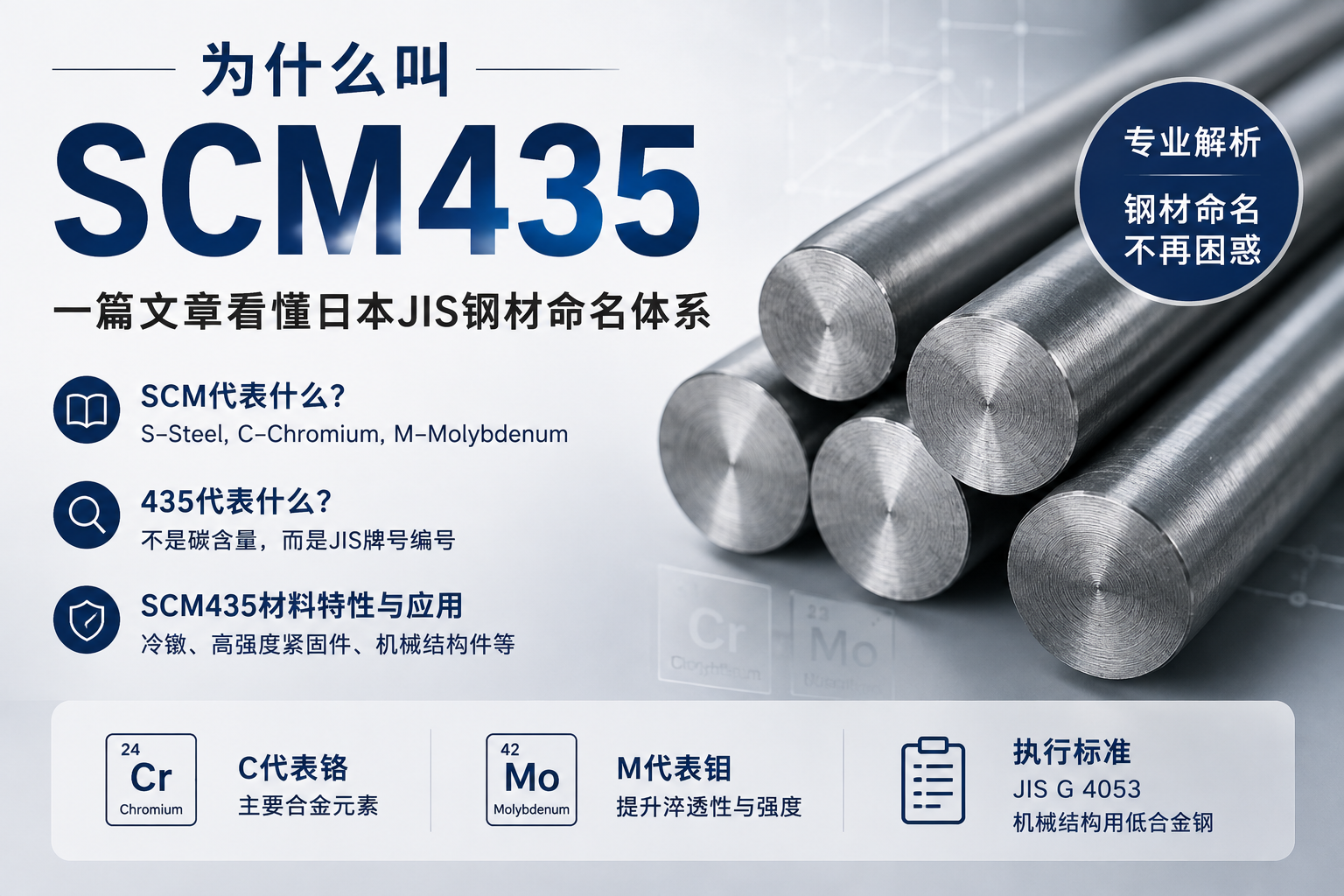
Why is it called SCM435?
Understand the Japanese JIS steel naming system in one article
In the automotive fastener, mechanical manufacturing, and cold heading material industries, SCM435 is virtually known to everyone.
However, if you continue to ask:
Why is it called SCM435?
Not many people can explain it clearly.
Many people know:
SCM435≈34CrMo4≈35CrMo≈AISI 4135/4137 series.
But:
What do the three letters SCM stand for?
And what do the three digits 435 represent?
Today, starting from the JIS standard, we will thoroughly explain SCM435 once and for all.
I. Which standard does SCM435 come from?
SCM435 belongs to the Japanese Industrial Standard:
JIS G 4053
Low-Alloyed Steels for Machine Structural Use (low-alloy steels for machine structural purposes).
It falls under:
Machine Structural Alloy Steel
and not:
* Stainless steel;
* Tool steel;
* Spring steel;
* Bearing steel.
II. What exactly does SCM mean?
The most distinctive feature of JIS material naming is:
The letters at the beginning indicate the type of steel.
For SCM:
S
Steel
Steel
indicates:
Steel material.
C
Chromium
Chromium (Cr)
indicates:
One of the main alloying elements is chromium.
M
Molybdenum
Molybdenum (Mo)
indicates:
The other major alloying element is molybdenum.
Therefore:
SCM
is:
Chromium-Molybdenum Steel (chromium-molybdenum steel)
This is also the most significant characteristic of SCM435.
It belongs to:
Cr-Mo Alloy Steel (chromium-molybdenum alloy steel).
III. What does 435 mean?
Many people mistakenly believe:
435
represents:
0.35% carbon (C)
However:
This is not the case.
This is the most easily misunderstood aspect of the Japanese JIS naming convention.
435 does not indicate carbon content
In SCM435:
435
is simply:
A grade number specified by JIS.
It is used to distinguish between:
SCM410
SCM415
SCM420
SCM425
SCM430
SCM435
SCM440
SCM445
and other different grades of steel.
However:
As the grade number increases,
The carbon content of the material generally rises as well.
For example:
Grade Typical C (%)
SCM415 0.13–0.18
SCM420 0.18–0.23
SCM425 0.23–0.28
SCM430 0.28–0.33
SCM435 0.33–0.38
SCM440 0.38–0.43
SCM445 0.43–0.48
As you can see:
435 does not mean:
0.435% carbon.
Instead, it corresponds to:
the range of materials with about 0.33–0.38% carbon.
IV. Why isn’t it called SCM35?
Many engineers often ask:
Why doesn’t Japan just call it:
SCM35?
In fact:
This is determined by the JIS naming system.
JIS does not follow a naming convention like:
35CrMo
Instead, it uniformly adopts:
A four-digit numbering system.
Therefore:
SCM435
is simply:
A result of JIS naming rules.
It is not:
435 = 0.435% carbon.
V. What is the relationship between SCM435 and 35CrMo, 34CrMo4?
Many customers often ask:
Is SCM435:
35CrMo?
The answer is:
Close, but not equivalent.
Because:
They originate from:
Grade Standard System
SCM435 JIS
35CrMo GB/T
34CrMo4 EN
AISI 4135 / 4137 SAE/AISI
Although:
The chemical compositions are very similar,
However:
The applicable standards differ;
The allowable tolerances vary;
The technical requirements may also differ.
Therefore:
In international trade,
Supplies should still be provided according to the customer-specified standard.
VI. Why has SCM435 become one of the most common alloy steels in the cold heading industry?
For high-strength fasteners, SCM435 offers good:
* Hardenability;
* Strength;
* Toughness;
* Cold heading performance;
* Heat treatment stability.
Therefore, it is widely used in:
* High-strength automotive bolts;
* Construction machinery fasteners;
* High-strength mechanical parts;
* Shaft components;
* Gears;
* Pins, etc.
However, what truly affects cold heading performance is:
not only the SCM435 grade itself.
It also includes factors such as:
* Spheroidized structure;
* Non-metallic inclusions;
* Surface quality;
* Decarburization control;
* Wire drawing process;
* Delivery condition.
These factors are often more important than the grade designation itself.
VII. What should we understand when we see SCM435?
Truly professional engineers, upon seeing:
SCM435,
do not simply read it as:
"A type of steel."
Rather, they interpret it as:
S —— Steel (steel)
C —— Chromium (chromium)
M —— Molybdenum (molybdenum)
435 —— A JIS-designated chromium-molybdenum steel grade number, corresponding to approximately 0.33–0.38% carbon, rather than indicating 0.435% carbon.
This is how one truly understands:
SCM435.
Conclusion
SCM435 is not an arbitrarily named steel grade.
It originates from Japan’s JIS G 4053 “Low-Alloyed Steels for Machine Structural Use,” where:
* S stands for Steel (steel);
* C stands for Chromium (chromium);
* M stands for Molybdenum (molybdenum);
* 435 is a grade number within the JIS chromium-molybdenum steel series, corresponding to approximately 0.33–0.38% carbon, rather than indicating 0.435% carbon.
For the cold heading industry, understanding the material grade is only the first step. What truly determines material performance involves factors such as the applicable standard, chemical composition stability, spheroidized structure, non-metallic inclusions, surface quality, and delivery conditions. Only by comprehensively grasping these aspects can one correctly select and evaluate a cold heading material.