
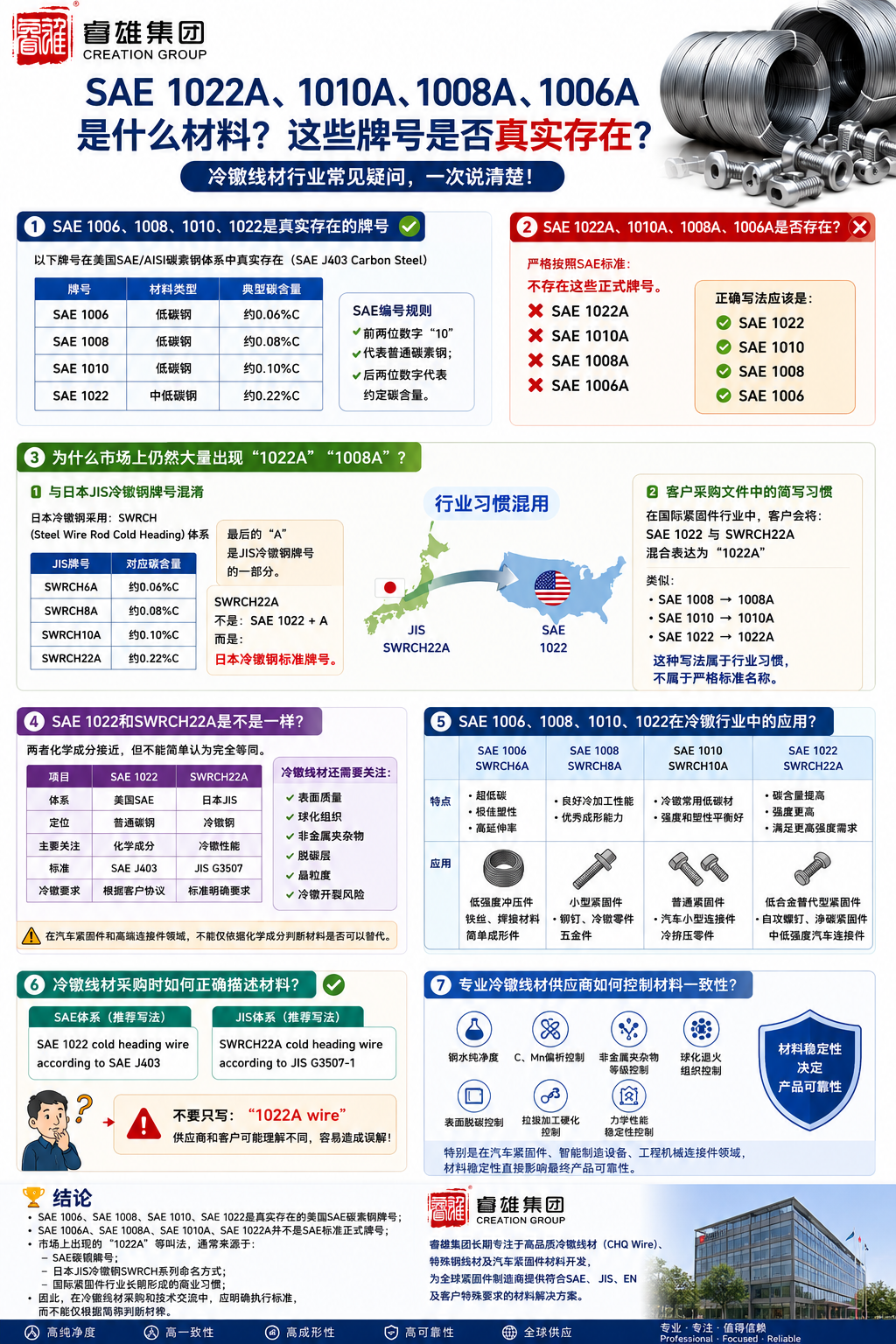
Are SAE 1022A, 1010A, 1008A, and 1006A real material grades?
— Analysis of Several Easily Confused Steel Grades in the Cold Heading Industry
In the cold heading wire (Cold Heading Wire / CHQ Wire) industry, many purchasing engineers, quality engineers, and even technical personnel often encounter inquiries such as:
* SAE 1022A Wire<br>* SAE 1010A Material<br>* SAE 1008A Cold Heading Wire<br>* SAE 1006A Steel Wire
At the same time, they frequently receive customer drawings, technical agreements, or purchase orders containing:
SAE 1022A
or
1008A Wire
Many people then wonder:
Are SAE 1022A, 1010A, 1008A, and 1006A official material grades under the American SAE standard?
In fact, this is one of the most common sources of confusion in the cold heading industry.
This article will provide a systematic analysis of this issue by combining the American SAE standards, Japanese JIS standards, and practical applications within the cold heading industry.
I. SAE 1006, 1008, 1010, and 1022 Are Real Material Grades
First, it’s important to clarify:
The following grades are all ordinary carbon steel grades specified in the American SAE J403 standard, “Chemical Compositions of SAE Carbon Steels.”
Material Grade Standard Type<br>SAE1006 SAE J403 Low-carbon steel<br>SAE1008 SAE J403 Low-carbon steel<br>SAE1010 SAE J403 Low-carbon steel<br>SAE1022 SAE J403 Medium-low carbon steel
All these materials fall under the category of:
Plain Carbon Steel (ordinary carbon steel)
The SAE numbering system is very straightforward:
* The first two digits, “10,” indicate ordinary carbon steel;<br>* The last two digits represent the nominal carbon content.
For example:
SAE Grade Typical Carbon Content<br>SAE1006 ≈0.06%C<br>SAE1008 ≈0.08%C<br>SAE1010 ≈0.10%C<br>SAE1022 ≈0.22%C
Therefore,
SAE1006, 1008, 1010, and 1022 are all genuine material grades recognized by U.S. standards.
II. So, Do SAE 1022A, 1010A, 1008A, and 1006A Exist?
The answer is clear:
According to SAE standards, none of these formal grades exist.
In other words:
❌ SAE1022A
❌ SAE1010A
❌ SAE1008A
❌ SAE1006A
are not officially listed in SAE J403.
The correct designations should be:
✅ SAE1022
✅ SAE1010
✅ SAE1008
✅ SAE1006
Thus, when procurement documents or drawings list something like “1022A,” it should not automatically be assumed to be an official U.S. SAE grade.
III. Why Is “1022A” or “1008A” Still Widely Used in the Market?
This usage stems from long-standing conventions within the cold heading industry.
1. Mixing of the SAE and JIS Systems
In Japan, cold heading steels follow the:
JIS G3507
grading system.
For example:
Japanese JIS Grade Carbon Content<br>SWRCH6A ≈0.06%C<br>SWRCH8A ≈0.08%C<br>SWRCH10A ≈0.10%C<br>SWRCH22A ≈0.22%C
It’s crucial to note here that the “A” is part of the JIS designation itself.
For instance:
SWRCH22A
is a complete grade.
It does not mean:
SAE1022 + A
2. Long-Standing Abbreviated Usage in International Fastener Markets
Because:
SAE1022
and
SWRCH22A
have very similar chemical compositions, many customers have gradually adopted shorthand expressions like “1022A” during their communications over the years.
For example:
SAE1008
↓
1008A
SAE1010
↓
1010A
SAE1022
↓
1022A
This type of expression primarily reflects industry business practices rather than official standardized designations.
IV. Can SAE1022 and SWRCH22A Be Considered Completely Equivalent?
Many engineers ask:
Is SAE1022 simply another name for SWRCH22A?
The answer is no.
Although their chemical compositions are very similar, they still originate from two distinct standard systems.
Item SAE1022 SWRCH22A<br>Standard System SAE J403 JIS G3507<br>Classification Ordinary Carbon Steel Cold Heading Steel<br>Key Control Points Chemical Composition Cold Heading Performance<br>Technical Focus Composition Composition + Microstructure + Surface + Processing State
Therefore,
In the automotive fastener industry, materials should generally be supplied according to the customer-specified standard, and equivalence cannot be determined solely based on chemical composition.
V. For the Cold Heading Industry, It’s Not Just About the Grade
Many purchasing engineers often specify only:
SAE1022
However,
for the cold heading industry, the grade is merely one component of the material definition.
What truly determines cold heading performance goes far beyond just chemical composition.
⸻
1. Chemical Composition Stability
Beyond meeting the requirements of SAE J403, it’s essential to control:
* Carbon segregation<br>* Manganese segregation<br>* Residual elements<br>* Overall compositional stability
Otherwise, issues may arise such as:
* Fluctuations in cold heading loads;<br>* Variability in heat treatment performance;<br>* Reduced product consistency.
⸻
2. Spheroidized Microstructure
The true focus for cold heading materials lies in achieving a fully spheroidized and uniform microstructure.
The quality of spheroidization directly affects:
* Cold heading forming force;<br>* Die life;<br>* Risk of cracking during cold heading;<br>* Subsequent heat treatment performance.
Therefore, the spheroidized microstructure is often more critical than the material grade itself.
⸻
3. Nonmetallic Inclusions
For automotive fasteners, it’s typically necessary to strictly control:
* Type A inclusions;<br>* Type B inclusions;<br>* Type C inclusions;<br>* Type D inclusions.
The inclusion levels significantly impact:
* Fatigue life;<br>* Cracking during cold heading;<br>* Quenching cracks;<br>* Overall product reliability.
⸻
4. Surface Quality
Cold heading materials are extremely sensitive to surface defects.
For example:
* Cracks;<br>* Folding;<br>* Imprints;<br>* Scratches;<br>* Decarburization.
Many cold heading failures are not caused by material strength but by surface imperfections in the raw material.
⸻
5. Delivery Condition
Even materials labeled as SAE1022 can differ greatly in delivery state.
For example:
* Hot-rolled coils;<br>* Spheroidized coils;<br>* Cold-drawn precision wire;<br>* Phosphated and soaped wire;<br>* Phosphate-free lubricated wire.
Different delivery conditions correspond to entirely different cold heading processes.
Therefore, when placing orders, it’s recommended to clearly specify:
* Material grade;<br>* Applicable standard;<br>* Processing state;<br>* Delivery condition,
rather than simply requesting “SAE1022.”
⸻
VI. How to Properly Describe Materials When Purchasing Cold Heading Wire?
To avoid misunderstandings in international trade, it’s advisable to use standardized descriptions.
For example:
Under the U.S. SAE system:
SAE1022 Cold Heading Wire according to SAE J403
Under the Japanese JIS system:
SWRCH22A Cold Heading Wire according to JIS G3507-1
Avoid using shorthand expressions like “1022A Wire,” as different suppliers may interpret them inconsistently.
⸻
VII. Why Do Professional Cold Heading Material Suppliers Focus More on Standards Than Abbreviations?
For high-quality cold heading wire, material stability depends not only on the grade but also on the entire manufacturing process.
Professional suppliers typically control:
* Molten steel purity;<br>* Chemical composition stability;<br>* Nonmetallic inclusions;<br>* Spheroidized microstructure;<br>* Surface quality;<br>* Decarburization prevention;<br>* Drawing process conditions;<br>* Consistency in mechanical properties.
Especially in sectors such as automotive fasteners, construction machinery, high-end connectors, and precision cold-headed components, these stringent controls are often more critical than the material grade itself.
Conclusion
SAE1006, SAE1008, SAE1010, and SAE1022 are genuine American SAE carbon steel grades.
However:
SAE1006A, SAE1008A, SAE1010A, and SAE1022A are not official grades under the SAE standard.
The “1006A,” “1008A,” “1010A,” and “1022A” seen in the market mostly originate from:
* Japanese JIS cold heading steel grades in the SWRCH series;<br>* Long-standing commercial abbreviations in the international fastener industry;<br>* Conventions arising from the mixed use of SAE and JIS systems.
Therefore, for cold heading wire procurement and technical exchanges, it’s always recommended to clearly specify the applicable standard rather than relying solely on abbreviated terms like “1022A” to determine material types.
About Creation Group
Creation Group specializes in high-quality cold heading wire (CHQ Wire), special-shaped wire, and advanced automotive fastener material solutions. We have long provided materials and customized services compliant with SAE, JIS, EN, ISO, and customer-specific technical specifications to the global automotive, fastener, and precision manufacturing industries.