
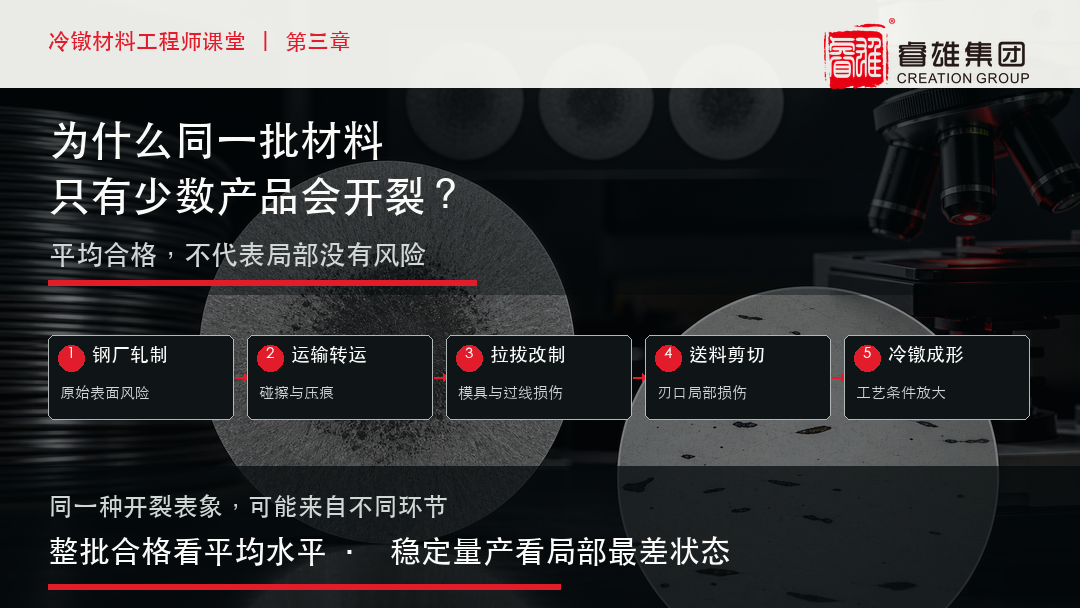
Chapter 3: Average Compliance Does Not Rule Out Local Risks
A common anomaly at cold heading sites is difficult to diagnose:
With the same batch of material, the same machine, and the same set of dies, most products are manufactured normally, while only a few occasionally crack. Upon rechecking the material certificates, chemical composition, hardness, and tensile strength, all results remain compliant.
Thus, many people ask:
If there’s an issue with the material, why doesn’t the entire batch crack?
The key lies in this:
The material certificate reflects representative results for the batch, whereas cold heading cracks may occur at the weakest localized points within the material.
I. A Few Cracks Do Not Necessarily Indicate a Problem Across the Entire Batch
Cracking during cold heading does not arise from a single cause.
From steel mill rolling, transportation and handling, wire drawing and remanufacturing, to feeding, shearing, and cold heading forming, any localized irregularity occurring at any stage can be amplified during subsequent severe deformation processes.
Therefore, “most parts normal, a few cracked” usually indicates that some local condition has changed—either in the material or in the production process.
This change might affect only a specific section of the coil, one side of the material surface, or a brief phase within continuous production, which is why it does not result in simultaneous cracking across the entire batch.
II. Local Risks May Originate Along the Entire Process Chain
1. Original Defects Formed During Steel Mill Rolling
During the rolling process, wire rod may develop folds, ears, cracks, embedded foreign matter, and other localized surface defects.
Some defects are not readily apparent when the wire is coiled; they gradually become visible after pickling, wire drawing, or cold heading deformation. Particularly in areas of high deformation, pre-existing defects can further propagate along the metal flow direction.
2. Mechanical Damage Caused by Transportation and Handling
Coiled wire and semi-finished wire, during lifting, stacking, and transfer operations, may sustain dents, scratches, or surface film damage due to impacts, friction, or localized compression.
These damages may not immediately cause problems, but once entering the cold heading process, they can become focal points for localized stress concentration.
3. Damage Introduced During Wire Drawing and Remanufacturing
Worn wire-drawing dies, abnormal die hole conditions, or burrs on idler wheels and guide rollers can create continuous or intermittent longitudinal scratches on the wire surface.
Such defects are sometimes hard to detect directly after phosphating and soap coating, but under the intense plastic deformation of cold heading, scratch locations may widen further, eventually leading to localized cracking.
4. Anomalies Generated During Feeding, Shearing, and Cold Heading Processes
Burrs at the wire-feeding points of the cold heading machine, worn shears or shear dies, and improper blade clearances can all damage the ends or surfaces of the blanks.
If the die fillets, concentricity, or step distribution are improperly designed, or if the single-stage upsetting ratio and localized deformation levels are excessively high, even materials meeting overall performance standards may still exceed their actual deformation capacity in certain local regions.
5. Local Weak Areas Exist Within the Material
but segregation was found、Inclusions or microstructural differences,Does not directly prove that the material is the cause of cracking。It is also necessary to determine whether these anomalies truly correspond to crack initiation points and cracking patterns。 Local segregation, coarse or clustered inclusions, localized microstructural non-uniformity, and certain abnormal metallurgical structures can all lead to differences in deformation capability at various locations within the material.
In most areas, the material deforms normally; however, local weak regions may be the first to develop microcracks under complex loading conditions, which gradually expand during subsequent forming operations.
III. Why Can Conventional Testing Still Be Qualified?
Additionally,Some defects are not original material defects from the steel mill,but during transportation、Drawing、Feeding、formed during shearing or cold heading processes。at this point, re-examining the original material certification is necessary,It's naturally difficult to find the answer。
Therefore:
Passing inspection only proves that the sample results meet requirements,Does not mean every location on the entire coil、Each subsequent process has no localized risks。 A single coil of wire can extend for several kilometers, whereas chemical composition, microstructural, and mechanical property tests only represent a limited number of sampling locations.
If local anomalies do not happen to be included in the test samples, the results may appear entirely satisfactory.
IV. The Real Challenge Is Not Listing Causes, But Locating the Origin
professional judgment truly addresses: Occasional cracking may originate from the material itself, or from tooling, equipment, and process conditions; alternatively, pre-existing minor local defects might be exacerbated by subsequent high-strain deformation and process fluctuations.
Only a few products crack from the same batch material,not contradictory。
steel mill rolling、transportation handling、drawing modification、Feed shearing、die process and internal material condition,May all introduce localized risks。
in Chapter Three, remember just one sentence:
Batch acceptance reflects the average batch level,Stable mass production, however, tests the worst local conditions。 This requires comprehensive assessment based on crack morphology, occurrence locations, coil segments, production patterns, and site operating conditions. As for specific sampling procedures, methods to distinguish defect origins, and sequencing of verification steps, these must be tailored individually according to product design and site circumstances.
- Defects initially formed at which specific stage;
- Why they affect only a limited number of products;
- And under what conditions they escalate into cracking.
- Where exactly did the defect first originate?
- Why does it only impact a small subset of products?
- And under what circumstances does it grow into visible cracking?
Next episode preview
Chapter 4:《spheroidization rate qualified,Why does cold heading deformation resistance still fluctuate?》 When encountering sporadic cracking incidents, the priority is not immediately determining whether the issue lies with the material or the customer’s process, but rather pinpointing the exact stage where the defect originated and subsequently amplified. Only when evidence clearly correlates can responsibility assessments and corrective actions become meaningful.