
Chapter 8: Product Structure and Forming Stages
A common situation often occurs on cold heading production lines:
With the same material grade and the same specification, producing ordinary bolts goes smoothly; however, when switching to products with large heads, thin flanges, deep holes, or multiple steps, issues such as insufficient filling, folding, eccentricity, and even cracking begin to appear.
In such cases, many people’s first reaction is: “Is this batch of material defective?”
In fact, the material hasn’t changed—the only thing that has changed is how the product requires it to flow.
Cold heading isn’t simply shortening the steel; rather, it involves redistributing the limited material according to the product structure.
This chapter will not yet delve into materials, coatings, or equipment, but will focus solely on how product structure and forming stages affect material flow.
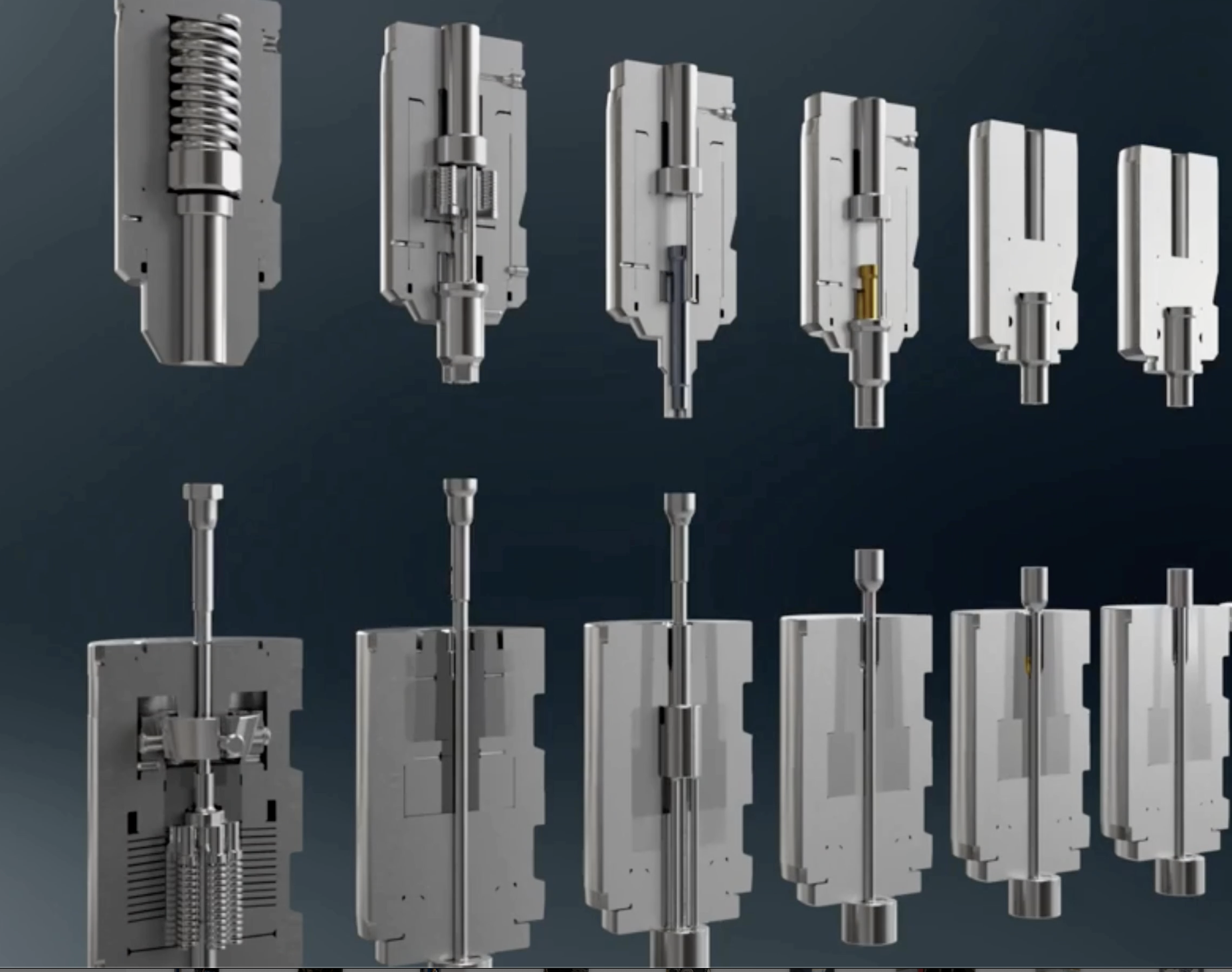
Schematic diagram of a multi-station forming process: each station completes only a portion of the material transfer.
I. Where Does the Material Go During Cold Heading?
During cold heading, the amount of material neither increases nor disappears out of nowhere; it merely flows from one location to another.
The extra material in the head comes from the original bar stock along the shank direction; an increase in flange diameter means the material must flow outward from the center; and when internal holes are required, the material must bypass the punch and redistribute itself around the hole area.
We can think of cold heading as planning a route for the material:
Which part flows forward;
which part flows outward;
which position deforms first;
which position forms later;
whether everything is completed in one step or divided across several stations.
The more direct the route and the smoother the transitions, the easier it is for the material to form uniformly; the longer the route and the sharper the turns, the more likely localized abnormalities will occur.
II. Which Product Structures Place Greater Demands on Material Flow?
1. Large Head, Thin Shank
The larger the head volume, the more material needs to be transferred from the shank.
If a large amount of material is pushed toward the head all at once, the central region may already be fully compressed while the outer edge has not yet spread evenly, ultimately leading to insufficient filling, localized folding, or edge cracking.
2. Wide Flange but Very Thin Thickness
Although a thin flange appears to require little material, it is actually quite difficult to form properly.
The material must flow outward over a considerable distance while maintaining uniform thickness. The flow in the central area and at the outer edge does not proceed in sync, with the outer edge typically becoming the weaker point.
Therefore, when dealing with large-flange products, we should not only consider the final diameter but also pay attention to how the material is gradually guided to the outer edge in earlier stages.
3. Abrupt Step Changes, Sharp Transitions
When a product suddenly shifts from a thick diameter to a thin one, or when adjacent sections lack smooth transitions, the material encounters what amounts to a sharp turn.
Some of the material gets blocked, while other portions continue moving forward, resulting in accumulation, folding, or uneven deformation at the boundary zone.
4. Deep Holes, Narrow Holes, or Thin-Walled Structures
When punching out an internal hole, the material does not disappear; instead, it is squeezed by the punch toward the surrounding area.
The deeper the hole and the thinner the wall, the higher the requirements for proper material distribution. If the preceding operation has not prepared adequately, forcing subsequent shaping can easily lead to uneven wall thickness, hole misalignment, or localized damage.
III. Why Can't Everything Be Done in a Single Operation?
Simple products can be formed in one step because the material moves only a short distance, and its flow direction is relatively straightforward.
If complex products also attempt to achieve “one-step forming,” it’s like trying to have many vehicles pass through a very narrow intersection at once: although their destinations are clear, there isn’t enough space in between to allow properdiversion.
The value of multi-station cold heading lies in breaking down overly large changes into smaller steps:
The preceding station prepares an appropriate blank shape;
intermediate stations guide the material flow to the desired locations;
subsequent stations complete dimensions, contours, and local details.
For example, a large-flange product might first form a relatively thick, small preformed head, then gradually expand outward, finally achieving the final flange dimensions.
This approach doesn’t simply increase the number of stations; rather, it ensures that each station handles only one primary task.
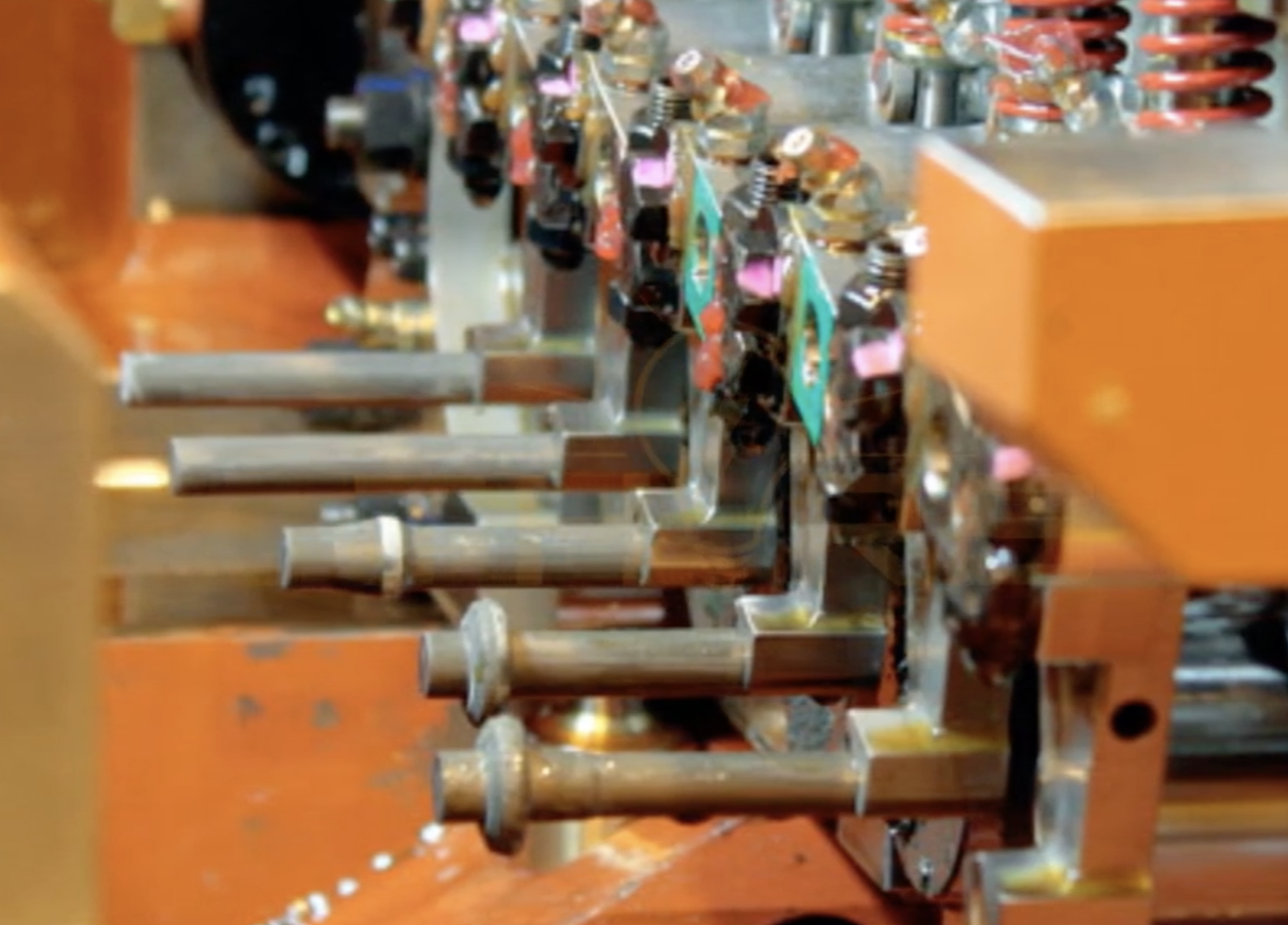
On-site view of a multi-station cold heading machine: the product is gradually formed as it passes through different stations.
IV. Is More Stations Always Better?
Not necessarily.
If the sequence of operations is arranged improperly, the material may flow outward at one station only to be forced back inward at the next; parts that were just formed get drastically altered again, leading to even greater concentration of deformation.
To determine whether the operation sequence is reasonable, consider these three questions:
Where does the material primarily flow in each step?
Are the flow directions consistent between adjacent steps?
Does any single step suddenly take on most of the shaping work?
A good forming path allows the material to approach the final shape step by step, rather than repeatedly changing direction.
V. Why Does the Same Material Behave Differently Depending on the Product?
The material itself provides a certain level of deformability, while the product’s structure determines how this capability is utilized.
A common bolt requires relatively mild deformation, leaving considerable reserve in the material; however, when switching to designs with large heads, thin flanges, deep holes, or complex steps, the same material may already be nearing the limits of what can be formed using the current process.
Therefore:
Normal production of standard products does not guarantee normal results for complex ones;
abnormalities in complex products do not immediately indicate material defects;
material properties, product design, and forming process must be evaluated together.
VI. How Should On-Site Troubleshooting Be Conducted?
Don't focus solely on the cracked finished part at the last station.
A more effective approach is to lay out the samples from each station in sequence and observe them side by side:
At which station does the anomaly first appear?
Which step shows the largest change in diameter or height?
Does the material suddenly accumulate at a particular location?
Are the flange, head, or hole wall gradually taking shape?
After adjusting the preform geometry, does the location of the defect shift?
If uneven flow has already appeared at the earlier stations, the final die typically only amplifies and exposes the problem.
In such cases, simply changing the material or repeatedly reworking the final die often fails to resolve the issue; it's even more important to verify whether the material distribution upstream is appropriate.
Engineer’s Perspective
The product drawing tells us what the final part should look like, while the process-step samples show us how the material gets there.
Material capability forms the foundation; the product design determines the destination, and the forming steps dictate the path the material takes to reach that destination.
You only need to remember one sentence from Chapter Eight:
Whether a material is suitable for cold heading depends not only on the material itself but also on where the product directs it to flow and how many times it flows.
When evaluating the suitability of cold-heading materials, Creation Group considers not only the grade, specifications, and test data, but also integrates the product drawing, raw-material diameter, number of stations, and samples from each forming step.
If you encounter a situation where “the same material works well for ordinary parts but causes problems with a different structure,” please send me the product drawing, material specifications, process-step samples, and details of the defective areas. I can help determine whether the issue stems from insufficient material capability or from deformation concentrated at inappropriate stations.
Next Episode Preview
Chapter Nine: “With the Same Material and Die, Why Does Performance Differ When Using a Different Machine?”
This chapter will focus on how machine rigidity, concentricity, lubrication supply, and thermal equilibrium during continuous production affect the actual process window.