
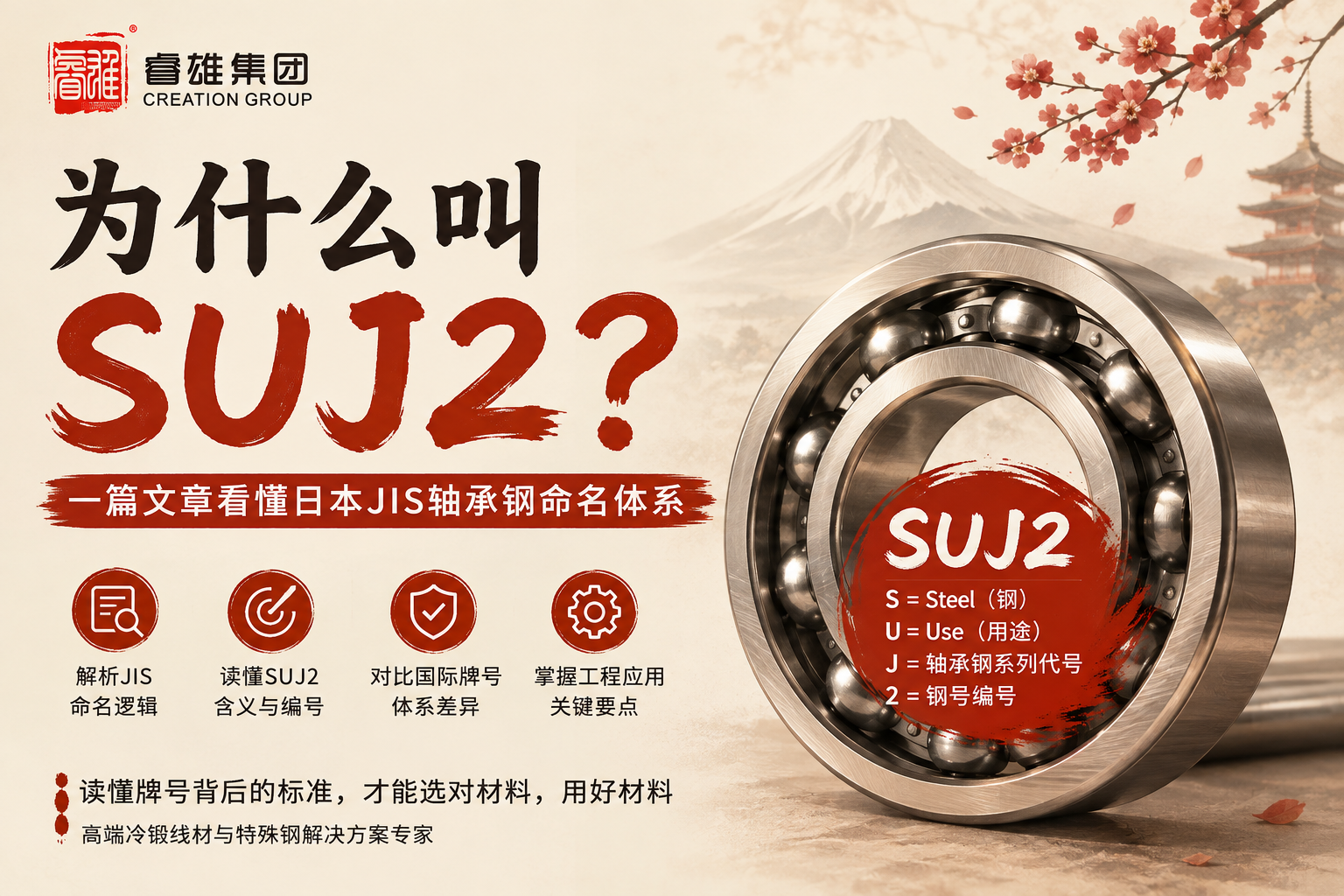
Why is it called SUJ2?
Understand the Japanese JIS steel naming system in one article
In industries such as bearing manufacturing, automotive components, precision machinery, and cold forming, SUJ2 is virtually known to everyone.
Many engineers know:
SUJ2 ≈ GCr15 ≈ 100Cr6 ≈ AISI 52100
But if you ask further:
Why is it called SUJ2?
Not many people can explain this clearly.
Many people know:
It is a high-carbon chromium bearing steel.
But few know:
Why was the grade SUJ2 named this way?
Today, we won’t discuss the properties of SUJ2; instead, starting from Japan’s JIS steel naming system, we will clarify this question.
I. Why do Japanese steels have such “strange” names?
Unlike European and American steels,
Japanese JIS steels are not simply named based on their chemical composition.
According to the "Methods for Designation of Steel and Alloy Grades in Japan,"
Japanese JIS steels are mainly divided into:
* Ordinary steels
* Special steels
* Cast steels
Among them,
Special steels include:
* Structural steels
* Tool steels
* Bearing steels
* Spring steels
* Free-cutting steels
* Stainless steels
In principle, Japanese steel grades consist of three parts:
① Material designation
② Steel category designation
③ Number indicating material type or specific characteristics
For example:
Grade Category
SCM435 Structural steel
SNCM220 Ni-Cr-Mo structural steel
SUP10 Spring steel
SK5 Carbon tool steel
SUJ2 Bearing steel
Therefore,
A Japanese steel grade is not just a name;
it is also a complete classification system.
II. Why is it called SUJ2?
According to the "Methods for Designation of Steel and Alloy Grades in Japan,"
SUJ belongs to:
The series of bearing steel grades.
Where:
* S —— Steel
* U —— Use (purpose)
* J —— Bearings
The number:
2
indicates:
The serial number within the SUJ series.
Thus:
SUJ2
does not mean:
* Second-generation bearing steel;
* 2% chromium content;
* 0.2% carbon content;
but rather:
The second steel grade in Japan’s JIS bearing steel series.
III. Which standard does SUJ2 come from?
Many people confuse:
The naming system
and
The product standard.
In fact:
SUJ2’s name originates from Japan’s steel grade designation system.
However:
The technical requirements for SUJ2
are specified by:
JIS G4805 "High Carbon Chromium Bearing Steels"
JIS G4805 defines:
* SUJ1
* SUJ2
* SUJ3
* SUJ4
* SUJ5
And several other bearing steel grades,
specifying separately:
* Chemical composition;
* Heat treatment requirements;
* Technical conditions;
* Inspection items.
Therefore,
grade naming
and
product standards
are two distinct aspects.
IV. Why has SUJ2 become the most common bearing steel?
As a high-carbon chromium bearing steel,
SUJ2 features:
✔ High hardness;
✔ Excellent wear resistance;
✔ Good rolling contact fatigue performance;
✔ Outstanding dimensional stability.
Consequently,
SUJ2 is widely used in:
* Ball bearings;
* Roller bearings;
* Ball screws;
* Precision guideways;
* Precision machine parts;
* High-wear-resistant components.
It is also one of the most widely used bearing steels worldwide.
V. Is SUJ2 the same as GCr15?
Many domestic engineers often ask:
Is SUJ2 the same as GCr15?
Strictly speaking:
The two are internationally equivalent steel grades.
For example:
Grade Standard system
SUJ2 JIS G4805
GCr15 GB/T 18254
100Cr6 EN ISO 683-17
AISI 52100 ASTM/SAE
Although:
Their main chemical compositions are very similar,
due to differing implementation standards,
Differences may still exist regarding:
* Permissible deviations in chemical composition;
* Non-metallic inclusions;
* Heat treatment requirements;
* Inspection items.
Therefore,
In international trade,
it is still recommended to supply materials according to the customer-specified standard.
VI. What should a professional engineer think first upon seeing SUJ2?
A truly professional materials engineer,
upon seeing a steel grade,
first thinks not about which country it corresponds to,
but rather:
Which steel grade system it belongs to.
For example:
Upon seeing the grade Initial judgment
SCM435 Mechanical structural steel
SNCM220 Ni-Cr-Mo structural steel
SUP10 Spring steel
SK5 Tool steel
SUJ2 Bearing steel
SUS304 Stainless steel
SUM24L Free-cutting steel
Understanding steel grade naming,
The greatest significance is not memorizing steel grades,
but rather:
Being able to quickly determine:
* Material category;
* Corresponding standard;
* Heat treatment route;
* Internationally equivalent materials;
* Possibility of substitution.
This is also a basic competency that materials engineers should possess.
VII. Why does Creation Group continuously study international steel grade systems?
Many people believe:
Material grades
are merely a string of characters filled out during procurement.
In reality,
for high-end cold-formed materials,
truly understanding materials begins with understanding standards.
Over the years,
Creation Group has continuously studied:
* JIS;
* ASTM;
* SAE/AISI;
* EN;
* ISO;
* GB/T
And multiple other international standard systems,
establishing a technical database covering cold heading wire, special section wire, bearing steels, structural steels, and automotive fastener materials.
Our goal is not only to provide a roll of material,
but also to help customers:
* Understand materials;
* Select materials correctly;
* Optimize processes;
* Achieve domestic substitution;
* Reduce overall manufacturing costs.
Because we always believe:
The best material suppliers don’t just sell materials; they help customers understand them.
⸻
Conclusion
SUJ2 is not an arbitrarily named steel grade.
According to Japan’s steel grade naming system,
SUJ belongs to the bearing steel series,
and the number 2 distinguishes different grades within that series.
Meanwhile, SUJ2’s chemical composition, technical requirements, and inspection specifications
are governed by JIS G4805 "High Carbon Chromium Bearing Steels."
Understanding steel grades
is not merely recognizing a material;
it is also comprehending an entire standard system.
For materials engineers,
what truly matters is not memorizing a steel grade,
but deciphering the standards behind it.
Standards and References
Product Standards
* JIS G 4805 "High Carbon Chromium Bearing Steels"