
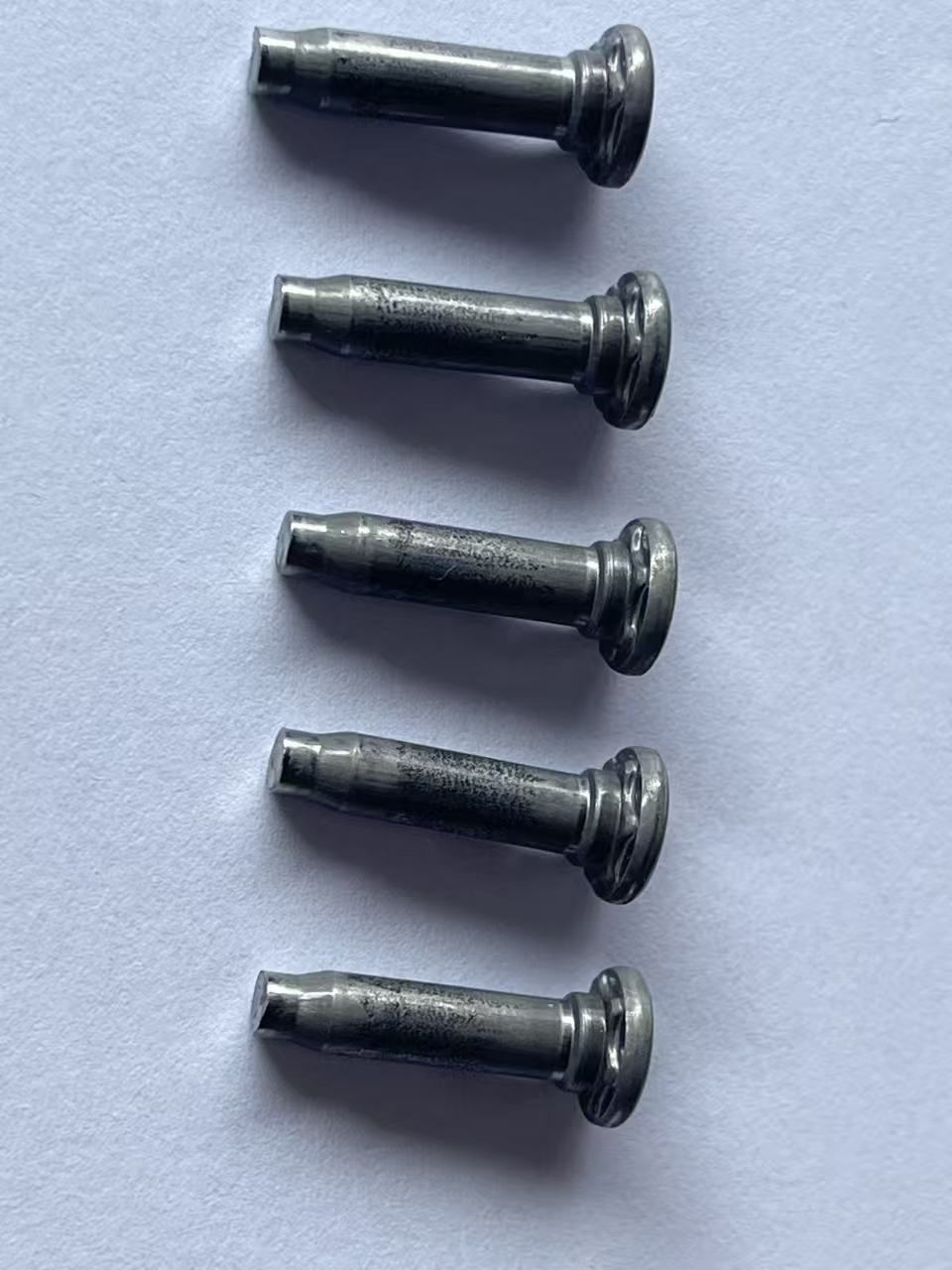
Chapter 7: A qualified coating does not necessarily mean effective lubrication after deformation
In cold heading operations, the following abnormalities are often encountered:
The surface color of the wire rod is uniform, and the weight of the phosphosaponification coating is also within the specified range. However, once it enters the cold heading machine, the coating may still flake or peel off, resulting in insufficient lubrication reserves, blackening of the workpiece, scratching, die sticking, accelerated die wear, and in severe cases, even cracking.
On-site personnel tend to attribute this issue simply to “poor phosphosaponification,” but the real problem is rarely that straightforward.
Case Study 1: Blackening on the shank of the workpiece is merely one manifestation of coating failure. Relying solely on color cannot directly determine the cause; it is also necessary to inspect the coating itself, the lubricant in the die cavity, and localized temperature rises.
The appearance and coating weight reflect the static condition before cold heading; what truly matters on-site is how much coating remains after drawing, and whether it can continue to adhere, extend, and provide lubrication under high pressure, frictional heat, and significant deformation.
I. Phosphosaponification Should Not Be Judged Solely by Total Coating Weight
Creation Group has made tracking the three residual coating layers after wire drawing a routine monthly quality-control task. This report covers 20 mass-produced steel wire grades and specifications, with three post-drawing samples taken from each grade to monitor the residual weights of the three coating layers.
In engineering terms, these layers can be understood as follows:
Zinc phosphate: forms the load-bearing framework and provides an adhesive base for the lubricant;
Zinc stearate: the combined lubricating layer formed through saponification;
Sodium stearate: supplies the lubrication reserve required for subsequent drawing and cold heading.
Besides measuring coating weight, routine monitoring also incorporates SEM observation of the crystal morphology, coverage, and distribution variations on the coating surface. While coating weight answers “how much remains,” SEM provides insight into “what the surface looks like”; only when both are considered together can a more reliable assessment be made than judging solely by the wire’s color.
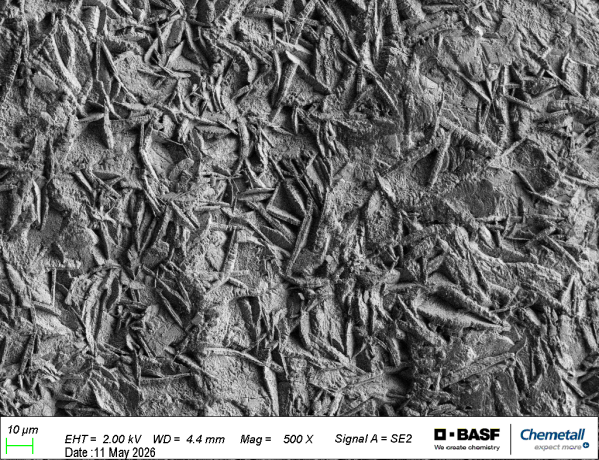
SEM images of the phosphating coating obtained during routine monthly inspections are used to observe the crystal morphology, coverage, and distribution differences on the coating surface. A single image cannot replace multi-point sampling and actual cold-heading verification.
The phosphating coating weight tests reported here follow GB/T 11376-2020. Compared to measuring only the total pre-treatment coating weight, separating and examining the three residual layers after drawing better reflects the true condition of the material as it enters the cold heading machine.
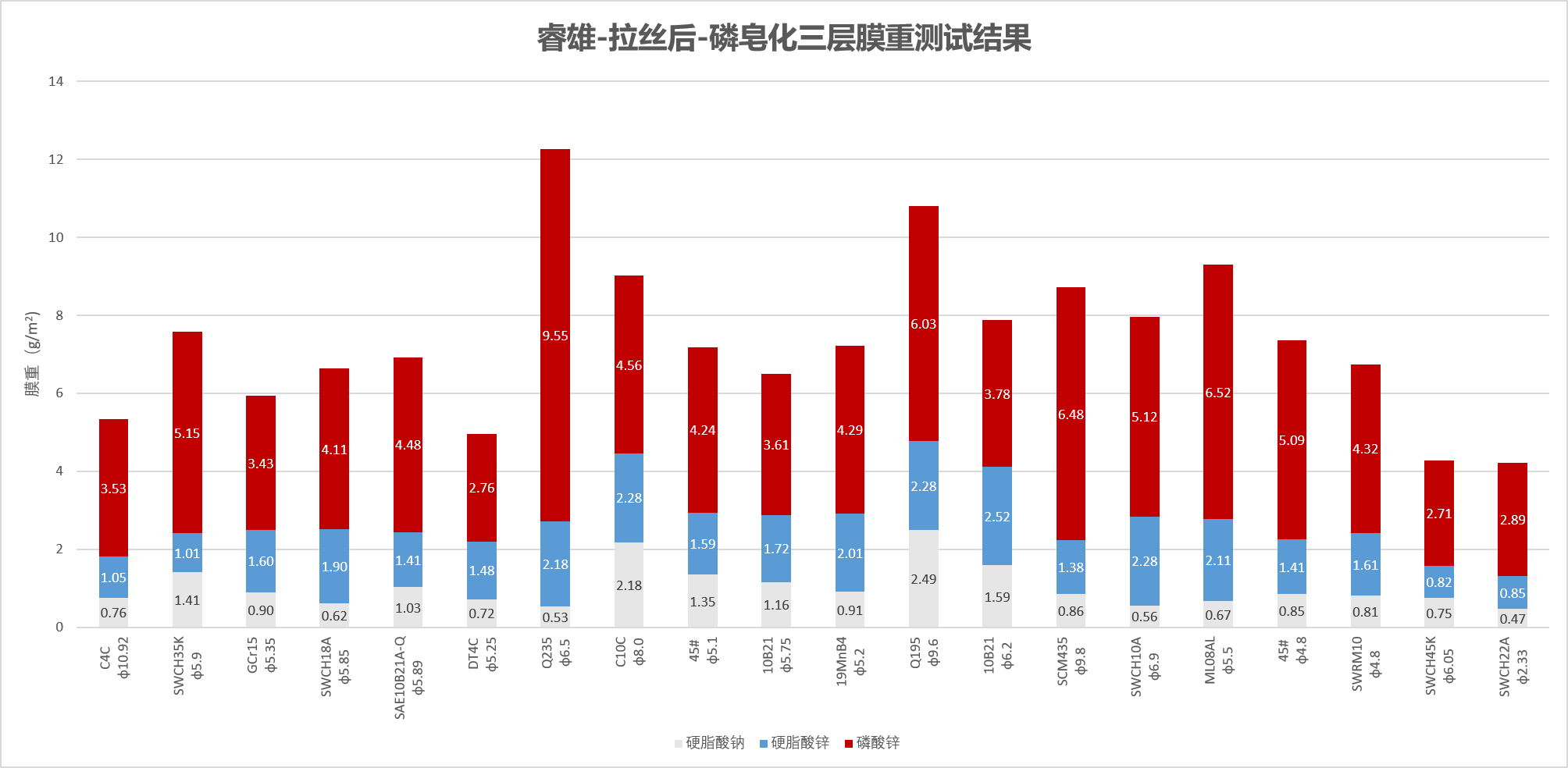
Original charts from Creation Group’s monthly report: measured results of zinc phosphate, zinc stearate, and sodium stearate remaining on 20 mass-produced materials after drawing.
All the monthly data presented here fall within the normal control range, indicating that the phosphosaponification process and the three residual coating layers after drawing are generally stable. The purpose of presenting this report is not to prove that there are problems with the materials, but rather to emphasize that the state of the coating cannot be judged solely by its appearance; continuous testing is needed to confirm the stability of the process.
However, passing the coating weight test only indicates “how much remains at the time of sampling” and does not independently answer whether the coating will crumble or peel off during high-speed cold heading, whether it can withstand localized temperature increases, or whether it is compatible with the lubricant in the die cavity. These are precisely the key issues discussed in this article.
II. Why might a "well-performed" coating behave differently after wire drawing?
The coating weight at the completion of phosphating and saponification only indicates that the coating has formed.
Phosphate coatings cannot extend continuously like the steel substrate itself. After wire drawing, the coating simultaneously experiences compression, shear, and surface stretching: some lubricant layers are removed or redistributed; if the coating lacks sufficient ductility or insufficient adhesion to the steel substrate, micro-cracks, flaky fractures, or even localized spalling may occur.
The presence of minor cracks in the coating does not necessarily mean it has failed. What truly matters is whether extensive areas of the metal substrate are exposed after cracking, whether the saponified lubrication layer can still provide coverage, and whether the remaining coating can withstand subsequent cold heading deformation. If local areas become bare, the material is more prone to increased friction, surface scratches, or die sticking once it enters the die cavity.
Therefore, even if two coils have similar coating weights after phosphating and saponification, differences in reduction ratios and the number of drawing passes can still lead to variations in coating fracture levels, coverage, and effective residual film thickness.
This is also why Creation Group’s monthly testing focuses on “how much remains after drawing,” rather than simply pursuing higher initial coating weights before treatment.
III. Burning is just one manifestation of coating failure
Strictly speaking, many so-called “coating burnings” are not phosphate crystals actually burning like organic materials.
During cold heading, both deformation heat and frictional heat are generated simultaneously. If the saponified lubrication layer or the mold-cavity lubricant lacks adequate temperature resistance, softening, thermal degradation, decomposition, or carbonization of residues may occur.
At the same time, the phosphate coating structure may be crushed, thinned, or delaminated. Once lubrication protection fails, localized direct contact between the workpiece and the die occurs, potentially leading to abnormalities along the following sequence:
Thermal degradation of the lubrication layer → Reduced load-carrying capacity of the oil film → Localized metal-to-metal contact → Blackening, surface scratching, die sticking, and abnormal die wear.
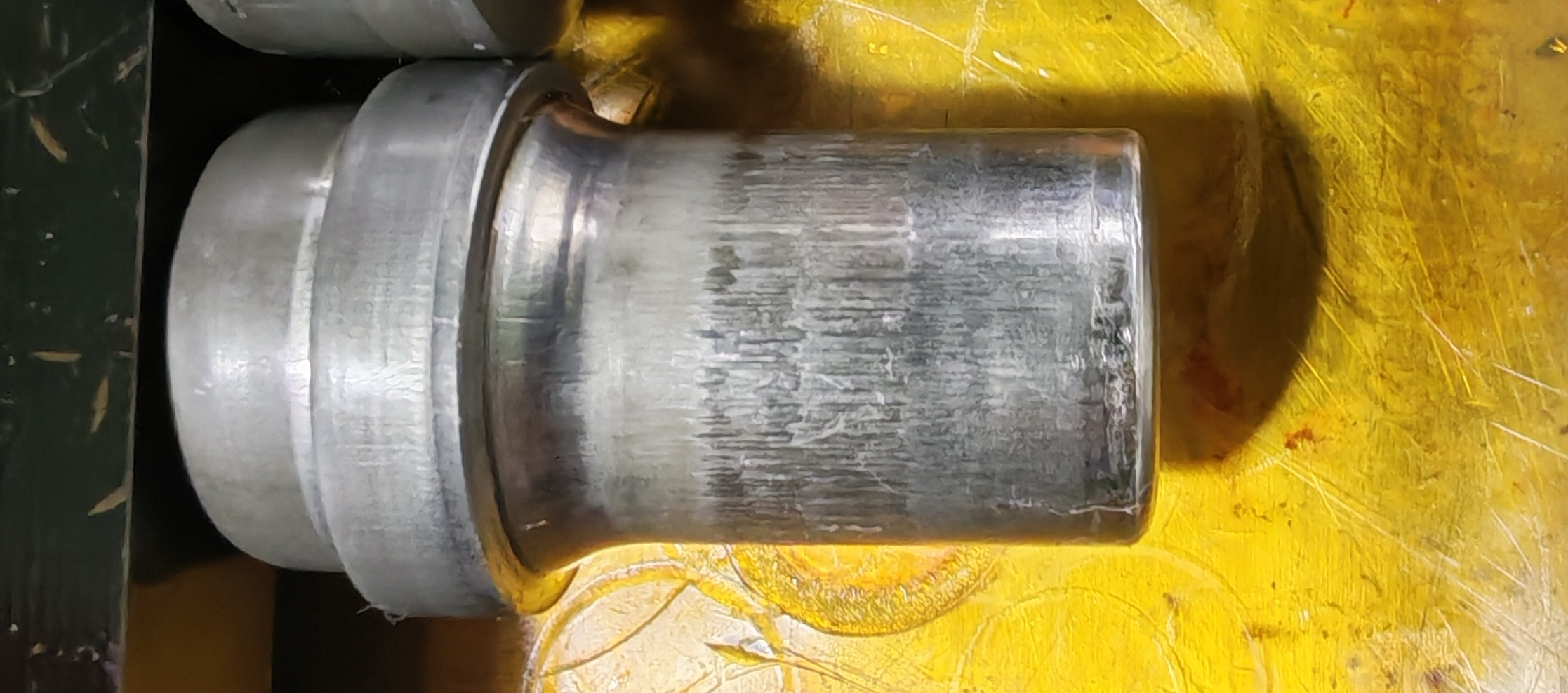
Field Case 2: Obvious longitudinal scratches have appeared on the surface, indicating that the issue likely progressed from lubrication-layer failure to direct metal-to-metal contact and adhesive wear.
Therefore, observing blackening on the workpiece surface merely suggests a possible anomaly in the lubrication system; one should not conclude directly that the problem lies with the phosphating process based solely on color.
IV. Neither the coating nor the mold-cavity lubricant can be overlooked
The phosphating-saponification coating provides basic protection for the material before it enters the die, while the mold-cavity lubricant must continue to supply lubrication during forming and dissipate some heat.
Even if the residual coating on the wire is in good condition, if the viscosity of the mold-cavity lubricant drops too quickly, its temperature resistance is inadequate, or it cannot consistently reach areas of high deformation, surface blackening and scratching may still occur.
Conversely, if the effective residual coating on the wire is already insufficient after drawing, simply increasing the amount of mold-cavity lubricant may not restore the original lubrication conditions.
The coating lays the foundation, the lubricant ensures ongoing protection; what ultimately determines the outcome is how well the two systems match under specific dies and process conditions.
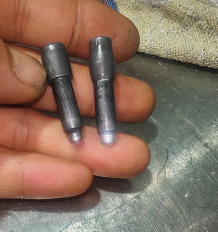
Field Case 3: Small-sized workpieces exhibit localized blackening. Although the affected area is small, it still requires assessment in conjunction with the workstation involved, production speed, and continuous production patterns.
V. What Does a Temperature Resistance ≥ 900°C Mean in Severe Cold Forging Conditions?
The current coating system used by Creation Group achieves a temperature resistance of over 900°C, providing ample thermal stability reserves for high-deformation cold forging.
It should be noted that the temperature resistance rating of the coating reflects the stability of the film under high temperatures; it does not mean that all die-lubricating oils will maintain identical viscosity and lubrication performance at 900°C. Actual mass production still depends on the coordinated compatibility among the coating, residual film, die cavity lubricant, and forming steps.
In the verification of SCM435 products, the strength-to-burst ratio reached 79.8%. Under the combined conditions of the coating system, post-drawing residual film, die cavity lubrication, and forming processes, stable mass production has been achieved.
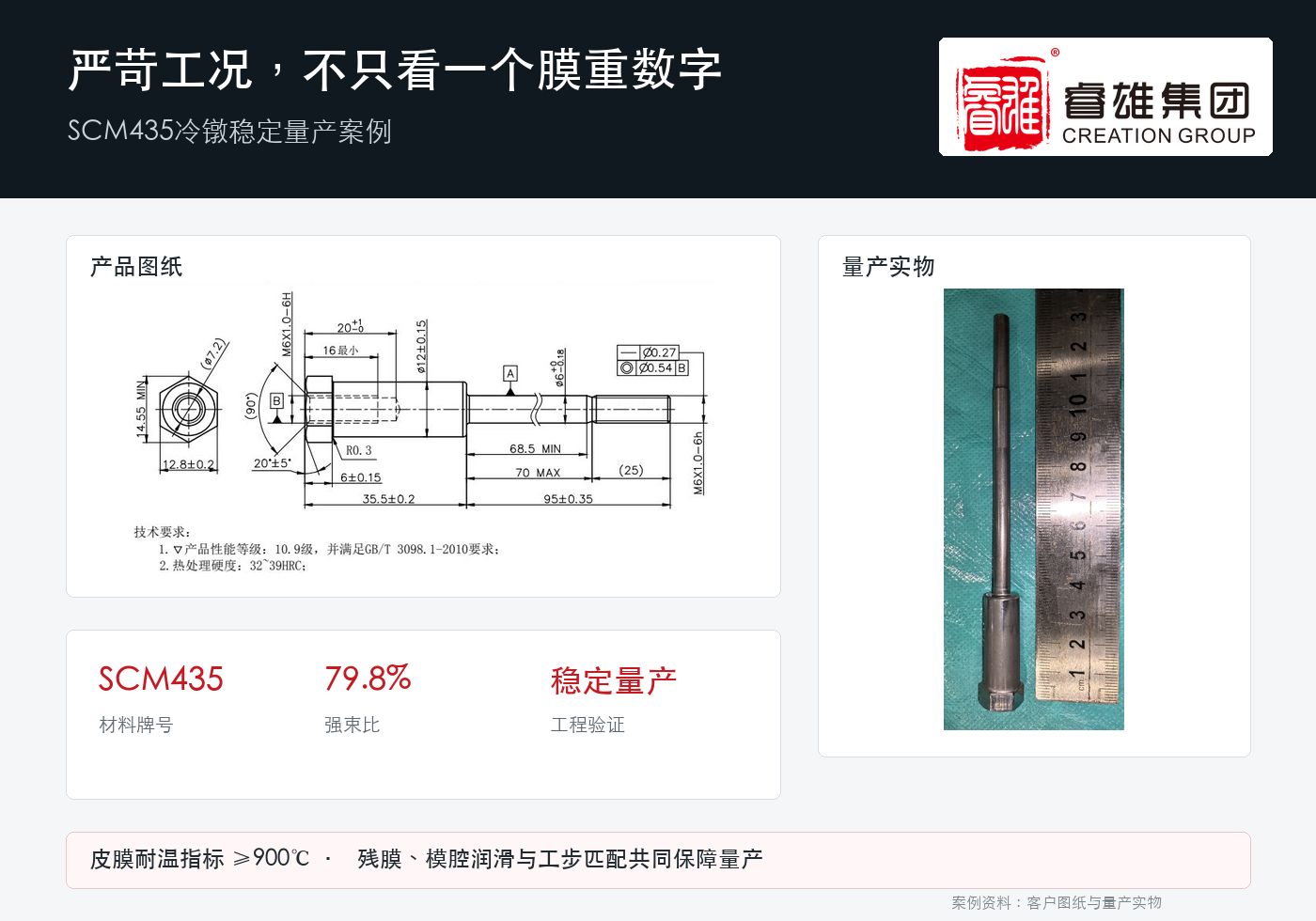
Mass Production Case of Severe Cold Forging for SCM435: Strength-to-Burst Ratio of 79.8%, Achieved Through Systematic Process Matching and Stable Mass Production.
This case demonstrates that what truly matters is not merely a single temperature-resistance figure or a one-time film-weight test, but rather whether the material can consistently and stably produce qualified parts under demanding deformation conditions.
Engineer’s Perspective
The real value of phosphating and saponification lies not in making the material appear uniform upon storage, but in ensuring that after drawing and continuous cold forging, the coating still adheres to the areas requiring protection, maintains sufficient lubrication reserves, and continues to safeguard both the workpiece and the die.
In Chapter Seven, just remember this sentence:
A normal appearance before treatment is only the starting point; having adequate effective residual film after drawing, which neither crumbles nor peels off, and retains its lubrication under deformation, temperature, and die-cavity lubrication conditions, is the true guarantee of mass production.
If you are also experiencing issues such as coating crumbling, peeling, blackening or burning of workpieces, burring, sticking to the die, or abnormal tool life, please send us the material grade, specifications, dimensions before and after drawing, affected stations, and on-site photos. Creation Group can first help determine whether the problem should be traced back to residual coating, adhesion status, die cavity lubrication, or temperature and friction conditions.
Next Episode Preview
Chapter Eight: “The Material Hasn’t Changed—Why Is It Difficult to Forge After Switching Product Designs?”
The next chapter will focus on how product design, fillet radii, single-pass deformation amounts, and step allocation affect the material’s flow path within the die.