
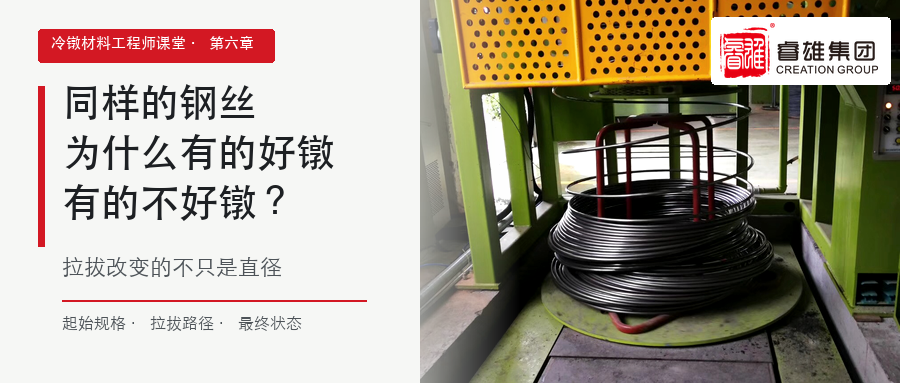
Chapter 6: When the Wire Is Drawn Thinner, the Material’s Properties Change Too
A common scenario occurs at cold heading sites:
The material grade is the same, the steel mill is the same, and the final wire diameter is identical; yet when fed into the cold heading machine, one batch produces smoothly, while another exhibits unstable forming, incomplete head filling, and occasional cracking.
Where does the problem lie?
Many people assume that wire drawing merely reduces the wire diameter, and as long as the dimensions are correct, everything is fine.
In fact, it’s not that simple.
Drawing doesn’t just change the diameter; it also affects how well the material will perform in subsequent cold heading.
I. Same Destination Doesn’t Mean Taking the Same Path
If both batches are drawn down to 10 mm, one may have started from 11 mm, while the other began at 13 mm.
The more a wire is drawn, the harder and stronger it typically becomes, which in turn alters the forming force required during subsequent cold heading operations.
Therefore, to assess whether a material is suitable for cold heading, you shouldn’t focus solely on its final specifications; you must also consider:
How thick it was originally and how much total reduction it has experienced.
This is like two people reaching the summit of a mountain—one by cable car, the other by hiking. Although they stand at the same point, their physical condition is entirely different.
II. Drawing All at Once Versus Drawing in Stages Yields Different Results
To reduce a wire from a larger diameter to a smaller one, you can either make a large reduction in a single pass or gradually achieve it over multiple passes.
Drawing too much in one step increases the pressure, friction, and temperature between the wire and the die, potentially causing inconsistent changes between the surface and interior of the material.
Too many passes can likewise lead to cumulative effects of friction and deformation.
The real key lies in how each pass is configured, especially whether the final drawdown is properly adjusted.
The total amount of drawing matters, but so does how the final reduction is executed.
This explains why different re-drawing plants, even when using the same coil stock, may still produce materials with varying cold heading performance.
III. Steel Wire Also "Remembers" the Direction of Applied Force
During drawing, steel wire is primarily elongated in the forward direction.
During cold heading, the material is compressed and flows toward the head and outward to the sides.
In other words, the material has just experienced “tension” and will soon be subjected to “compression.”
After a metal undergoes deformation in one direction, if it is then loaded in the opposite direction, its initial deformation behavior may change. In engineering, this phenomenon is known as the Bauschinger effect.
To put it simply:
Steel wire remembers how it was previously stretched.
Although the tensile strength of the material increases after drawing, this does not necessarily mean that its resistance to deformation in the compression direction during cold heading will increase proportionally.
Therefore, when evaluating a material after drawing, one should not rely solely on tensile strength and hardness; it is also necessary to consider the type of deformation the material will subsequently experience.
IV. Hardening and Directional Memory Coexist After Drawing
After drawing, materials generally become harder—a phenomenon known as work hardening.
However, when the material transitions from tension to compression, it is also influenced by the Bauschinger effect.
These two effects occur simultaneously:
- The greater the amount of drawing deformation, the higher the material’s resistance to further deformation tends to be;
- Once the loading direction changes, the material may begin compressive deformation at an earlier stage.
Which effect dominates at the initial stage and which prevails during subsequent deformation depends on the material grade, its original condition, and the extent of drawing.
Thus, it is inappropriate to conclude simply that “less drawing is better,” nor can we assert that “the more drawing, the better, thanks to the Bauschinger effect.”
What is truly needed is an appropriate processing range.
However, this optimal range varies depending on the material grade, dimensions, and intended product application.
V. Why Are Bainitic Non-Alloy Steels More Worth Noting?
For certain bainitic and high-strength non-alloy steels, the Bauschinger effect becomes particularly pronounced when transitioning from “tensile” deformation after drawing to “compressive” deformation during cold heading.
These materials already possess relatively high strength. Even after drawing, their tensile strength continues to rise, but their resistance to compressive deformation during cold heading may not increase proportionally.
This characteristic makes bainitic non-alloy steels especially noteworthy for cold work hardening and cold heading processes.
Consequently, assessing such materials requires considering not only their post-drawing tensile strength and hardness, but also integrating factors like the degree of drawing, production timing, and actual cold heading performance into a comprehensive analysis.
6. Why do materials still exhibit changes after being stored for a period of time?
Some materials show no issues when used immediately after drawing; however, their performance may change if they are stored for a while before production.
The reason is that the internal state of the wire does not necessarily stabilize right after drawing.
As storage time and temperature vary, the material’s strength and subsequent deformation characteristics can continue to adjust.
Therefore, when comparing two batches of material, in addition to checking the grade and test reports, you should also confirm:
- When each batch was drawn;
- How long each batch has been stored;
- Whether there are noticeable differences in the storage environment.
This seemingly simple information can often provide crucial clues for identifying the root cause of problems.
7. What should be compared when encountering issues?
If cold-heading performance differs between materials of the same grade and specification, it is recommended to first compare the following information:
- The original dimensions before drawing;
- The final dimensions after drawing;
- The number of drawing passes in between;
- Whether the reduction ratio of the last pass is identical;
- The production equipment and reprocessing dates of both batches;
- The storage duration after drawing for each batch;
- Whether the cold-heading anomalies vary with the reprocessing batch.
If the anomalies shift along with changes in the reprocessing batch, while the cold-heading equipment, dies, and products remain unchanged, then the drawing process of the two batches should be examined carefully.
The real judgment depends on whether the observed changes in the drawing process correlate with the material properties and the cold-heading abnormalities.
Engineer’s Perspective
Drawing is not merely reducing the wire diameter from a larger specification to a smaller one.
It also alters the material’s strength, its capacity for subsequent deformation, as well as how the material responds when transitioning from “tension” to “compression.”
Raw materials determine the foundation, while the drawing process decides the final state in which the material enters the cold-heading machine.
Thus, even among materials of the same grade and specification, some perform well in cold-heading while others do not. The problem may not lie in the material certification but could instead be hidden within the drawing process itself.
If you encounter inconsistent cold-heading performance with materials of the same grade and specification, please send me the material grade, dimensions before and after drawing, number of drawing passes, production dates, and photos of the defective parts.
I can help you initially determine whether to start troubleshooting from the raw materials, the drawing and reprocessing stages, or the cold-heading process.
Next Episode Preview
Chapter 7: “Despite Visible Phosphating and Saponification on the Surface, Why Do Problems Still Occur During Cold-Heading?”
The next chapter will focus on why having an apparent surface coating does not guarantee sufficient lubrication throughout the cold-heading deformation process.