
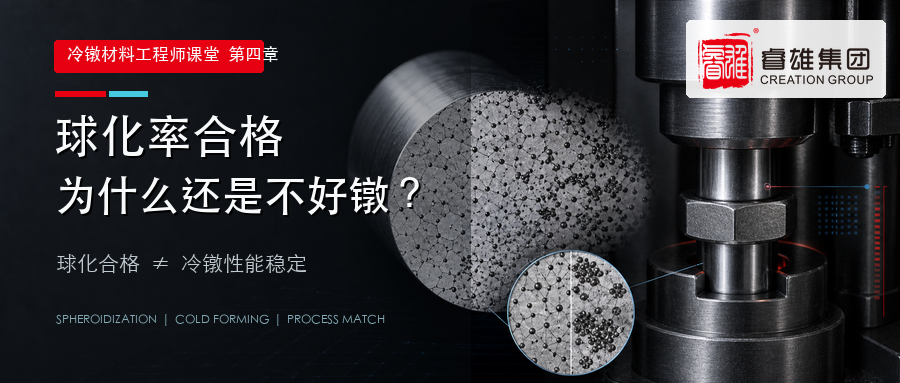
The purpose of spheroidizing annealing is to improve the cold-formability of medium-carbon steels and alloy steels.
However, when assessing materials on-site, “spheroidization rate” is often taken as the sole criterion. As long as the spheroidization rate and hardness are within specification, it is assumed that the material will perform well in cold heading.
But this is not necessarily true in actual production.
For the same grade, with similar hardness and identical spheroidization rates, some materials are easy to forge and form, while others make the machines work harder, leading to poor filling in complex sections and greater fluctuations in load and dimensions during continuous production.
The key point is:
Even if the spheroidization rates are the same, it does not mean the microstructure is identical, nor does it guarantee consistent cold-heading performance.
I. Spheroidization Rate Is Only Part of Microstructural Evaluation
The primary goal of spheroidizing annealing is to transform undesirable forms of carbides—such as lamellar or chain-like structures—into dispersed granular or near-spherical particles embedded in a ferritic matrix through processes like fragmentation, dissolution, reprecipitation, and coalescence.
This process mainly alters the morphology, size, and distribution of carbides.
Therefore, evaluating the spheroidized microstructure cannot rely solely on a single percentage; at least three additional aspects should be considered:
- Morphology: Are the carbide particles round? Do any lamellar, chain-like, or network features remain?
- Size: Are the particles excessively fine and densely packed? Are there locally coarse carbides?
- Distribution: Is the carbide distribution uniform? Does it vary between the surface, mid-radius, and core regions?
In particular, it is important to note:
Finer carbides are not always better, and coarser ones are not necessarily worse.
Carbide particles that are too fine and densely distributed may increase the material’s deformation resistance, whereas localized coarse particles or clustered aggregates can lead to non-uniform deformation.
What truly affects cold-heading performance is the interplay among carbide size, particle spacing, and overall distribution.
II. With the Same Spheroidization Rate, Ferrite Microstructure May Still Differ
A spheroidized microstructure consists not only of carbides.
During cold heading, carbides influence material deformation, while the ferritic matrix primarily accommodates plastic flow.
The grain size of ferrite, the degree of softening achieved, residual work hardening, and overall microstructural homogeneity all affect how easily the material deforms under cold heading.
Even when using similar spheroidizing annealing processes, differences in the original microstructure following hot rolling at the steel mill can result in varying degrees of spheroidization and matrix softening.
Thus, even if two metallographic images appear similar, the actual flow behavior of the material in the die may still differ significantly.
III. One Field of View Cannot Represent the Entire Cross Section
If you choose only one location and one field of view to take a metallographic photograph, you may very well miss localized clusters, banded distributions, or residual lamellar structures.
A single location passing inspection does not prove that the entire cross section is completely uniform; similarly, even if one cross section passes, it cannot guarantee that the entire coil of material is free from variations.
For a more professional assessment, consider:
- The microstructural differences between the surface layer, the mid-radius region, and the core;
This is also why, even when material certificates and individual metallographic photographs are all qualified, poor upsetting behavior can still occur on-site.
IV. Why Some Materials Are Easy to Form While Others Are Difficult, Despite Similar Hardness?
Hardness is important, but it represents only test results obtained at limited locations.
Cold heading involves continuous large plastic deformation. The material must not only initiate flow but also withstand progressively increasing deformation and work hardening in subsequent stations.
Therefore, for two batches of material with similar hardness, their performance at the first station might appear comparable; however, once they enter high-deformation or complex-forming stations, differences in load, filling, and die temperature rise may gradually emerge.
That said, if the machine struggles during forming, it doesn’t immediately indicate a material issue.
Die condition, lubrication supply, equipment rigidity, concentricity, and cumulative production temperatures can equally affect the actual loads experienced.
V. Ultimately, Microstructure Must Correspond with On-Site Performance
To determine whether a spheroidized microstructure is suitable for practical cold heading, one should not rely solely on spheroidization rate, hardness, or a single metallographic image.
A more effective approach is to integrate the following information:
- Metallographic structure and hardness distribution;
- Differences between normal and abnormal segments;
- Load variations observed on the cold-heading equipment;
- Product filling, dimensional accuracy, and die temperature rise;
- The specific station, timing, and coil segment where abnormalities occur.
Whether the microstructure is truly excellent ultimately depends on how the material flows after entering the die.
Engineer’s Perspective
Spheroidization rate is an important indicator for evaluating spheroidized microstructures, but it is not the definitive answer regarding cold-heading performance.
What truly determines whether a material is easy to upset is the morphology, size, and distribution of carbides, the state of the ferritic matrix, the uniformity across cross sections and coils, as well as the compatibility between the material and the actual process conditions.
Thus, in Chapter Four, remember just one sentence:
Spheroidization rate reflects only partial microstructural outcomes; whether a material is easy to upset hinges on the true deformation capability of its overall microstructure.
If both spheroidization rate and hardness are within specification yet the material still performs poorly during upsetting, repeatedly inspecting the same location usually yields little insight. Instead, focus on establishing the genuine correlations among microstructural differences, material segments, and on-site anomalies.