
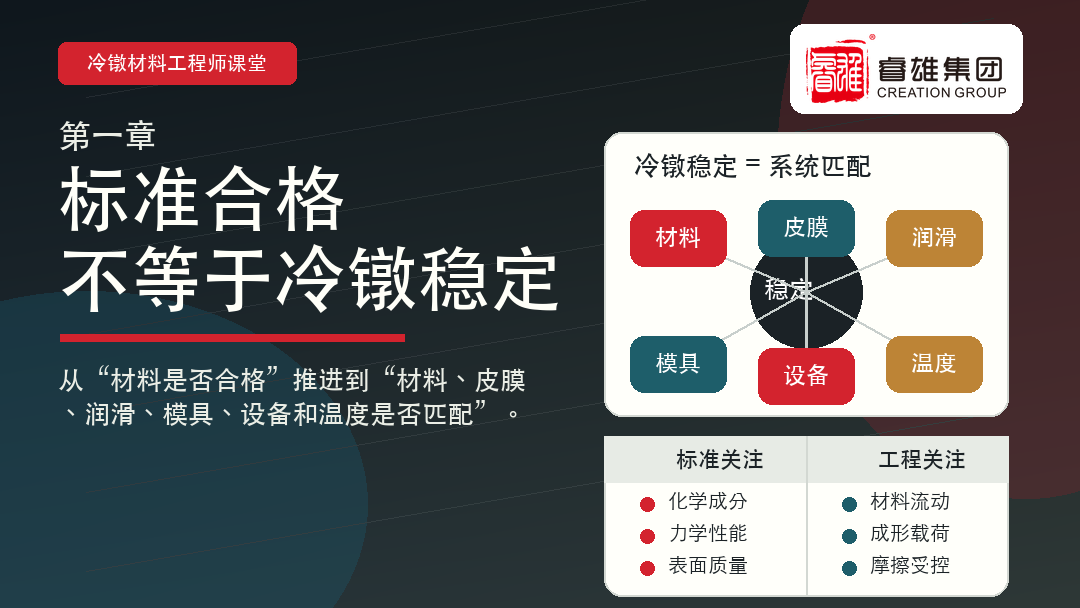
“Why do problems still occur in cold heading even when the material is qualified?”
The Material Is “Qualified,” So Why Do Problems Still Arise On-Site?
In cold heading production, a common situation often occurs:
After materials enter the factory, they come with complete certificates of conformity; their chemical composition meets the standards, and their tensile strength, hardness, and dimensional tolerances are all within the specified limits. If necessary, third-party testing is also conducted, yet the results still show compliance.
However, once these materials are actually loaded into the cold heading machine, issues begin to appear:
Cracking, folding, insufficient R-corner filling, fluctuations in product dimensions, abnormal die wear—even the same batch of material may behave completely differently on different equipment or with different dies.
At this point, the most common initial reaction on-site is:
Could there be something wrong with the material?
This assessment isn’t necessarily incorrect, but it’s also premature to draw conclusions too quickly.
Because in cold heading engineering, “material qualification” and “stable cold heading operation” are not the same thing.
Standards Address “Qualification”
The role of material standards is to specify the basic technical conditions that a material must meet.
For example:
- Whether the chemical composition falls within the prescribed range;
- Whether dimensions and allowable deviations comply with requirements;
- Whether mechanical properties such as tensile strength, reduction of area, and hardness meet the standards;
- Whether obvious surface defects exist;
- Whether the delivery condition matches the order or technical agreement;
- When necessary, whether inclusions, decarburization, microstructure, and other items satisfy the relevant provisions.
All of these aspects are extremely important.
Without standards, materials lack a common language for quality; without testing, it becomes difficult for both suppliers and customers to determine whether the material has met the agreed-upon requirements.
Therefore, standards form the foundation of material quality control.
However, standards primarily answer the question:
Does this batch of material comply with the specified requirements?
They do not directly address:
Under a particular customer’s part design, with a specific set of dies, on a certain cold heading machine, and under given lubrication conditions, can this batch of material ensure long-term stable production?
This is the fundamental difference between standard-based evaluation and engineering-based judgment.
What matters on the cold heading floor is “stability”
Cold heading is not simply pressing material into shape; it is a process in which the material undergoes significant plastic deformation within the die.
During this process, the material is subjected to the combined effects of compression, radial flow, localized tensile stress, shear, and friction.
The factors that truly determine on-site stability go beyond the material itself and include:
- Whether the product design is suitable for cold heading;
- Whether the die fillet radii are appropriately sized;
- Whether the single-pass reduction ratio is excessive;
- Whether the forming steps are reasonably distributed;
- Whether the equipment has sufficient rigidity;
- Whether the die concentricity remains stable;
- Whether the phosphate-soap coating is uniform and firmly bonded;
- Whether die lubrication can consistently reach areas of high deformation;
- Whether die temperatures are controlled during continuous production.
Therefore, what cold heading shops really care about is not merely whether parts are “qualified or unqualified,” but rather:
Once the material enters my process system, can it flow steadily, form reliably, and support stable mass production?
Why might qualified material still be unsuitable for a particular process?
The reason is simple: standards specify a range, while processes demand a precise match.
Even within the same grade, chemical compositions may fall within the standard limits, yet variations in elements such as C, Mn, Cr, Mo, and B can place them at different points within those ranges, leading to differences in deformation resistance, spheroidizing annealing response, and heat treatment performance.
Materials that meet surface quality requirements may pose no issues when used for components with moderate deformation. However, for parts involving high deformation, complex head geometries, or automotive safety components, even minor local defects can become magnified.
Similarly, although phosphate-soap coatings may appear compliant, if the adhesion is weak or the film lacks sufficient ductility, powdering or spalling after the first cold heading operation can turn subsequent stations into zones of severe dry friction.
It is also not uncommon for the same coil of material to produce stable results on one machine while encountering problems on another, due to differences in equipment stiffness, die precision, lubrication delivery, and die temperature control.
This indicates that the issue may lie not solely with the material itself, but with the compatibility between the material and the overall process system.
How should engineers make their assessment?
When faced with cold heading anomalies, it is inadvisable to hastily conclude that either the material or the customer’s process is at fault.
A more professional approach involves a layered investigation:
First, verify that the material complies with order specifications and technical agreements.
Second, assess whether the material meets the actual cold heading deformation requirements of the specific product.
Third, examine surface treatments, particularly the uniformity, adhesion, and ductility of the phosphate-soap coating.
Fourth, evaluate die design, fillet radii, step distribution, and per-pass reductions.
Fifth, inspect equipment rigidity, concentricity, lubrication supply, and die temperature stability.
Only by following this systematic procedure can we move from a “pass/fail judgment” to an “engineering assessment.”
Chapter Conclusion
The material meets the standard, which is a necessary but not sufficient condition for cold heading production.
The standard defines the minimum requirements for the material, while engineering controls ensure stable mass production.
Therefore, cold heading materials should not be judged solely on their material certificates, nor merely by grade and chemical composition.
A truly professional assessment of cold heading materials must return to the shop floor:
How will this coil of material flow once it enters the die?
Will there be fluctuations during continuous production?
Under the customer’s equipment, tooling, lubrication, and temperature control conditions, can it maintain long-term stability?
This is the real question that cold heading engineering must answer.
Thus, the central idea of Chapter One is:
Meeting the standard only indicates that the material has the basic prerequisites for production; true cold heading stability demonstrates that the material is genuinely matched with the process system.